Buyer’s Guide: Sourcing Heat Exchanger Production Lines from China
Jump to section
A heat exchanger production line is a set of machines that turn raw tubes and metal strip into finished coils. Many buyers now source these lines from China. The reason is simple: Chinese manufacturers offer complete supply chains, strong value, and flexible custom options.
This guide helps buyers, such as plant owners, factory managers, and procurement teams, make a smart choice. It explains the machines in a line, the key technical factors, and how to judge a supplier. It also covers cost, shipping, and payment. The goal is to help buyers source a heat exchanger production line from China with less risk.
What Is a Heat Exchanger Production Line?
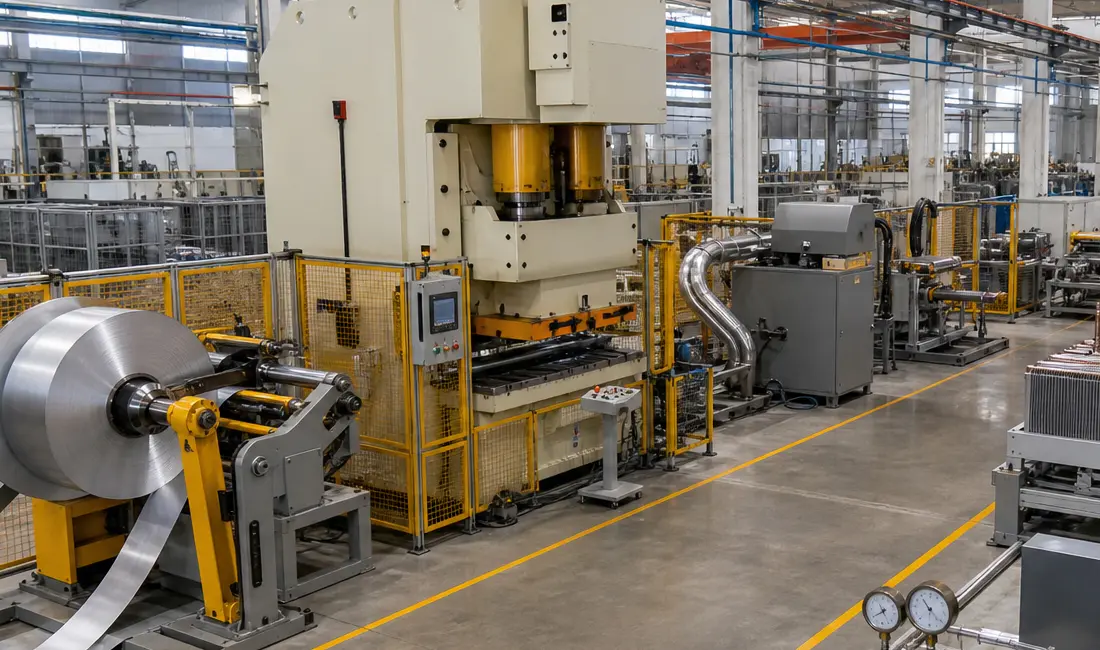
A heat exchanger production line is a chain of machines that build finned coils step by step. Each machine does one job. Together, they turn flat metal strip and straight tubes into a working heat exchanger. A full line can shape fins, cut and bend tubes, join fins to tubes, and test the result. Buyers do not have to buy every machine at once. Still, it helps to understand the whole flow before choosing any single part. The sections below walk through each stage in plain terms.
Core Machines in a Complete Production Line
A complete line usually includes five main groups of machines, such as fin presses, tube benders, tube expanders, welding stations, and test rigs. Each group handles one stage of coil production. The parts below explain what each machine does and why it matters.
Fin Press / Fin Line
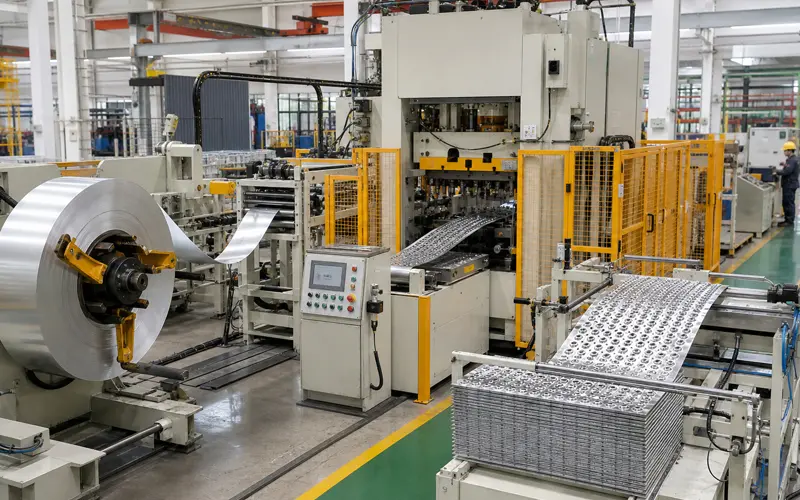
A fin press stamps fins from a thin metal strip. It uses a die to cut and form each fin. The die shape sets the fin type, such as louvered, slit, or wavy fins. Speed matters here. A high-speed fin line can run as fast as 300 strokes per minute. Faster output helps a plant fill large orders. A precise die also keeps every fin the same size, which protects coil quality.
Tube Cutting and Bending (Hairpin & Serpentine)
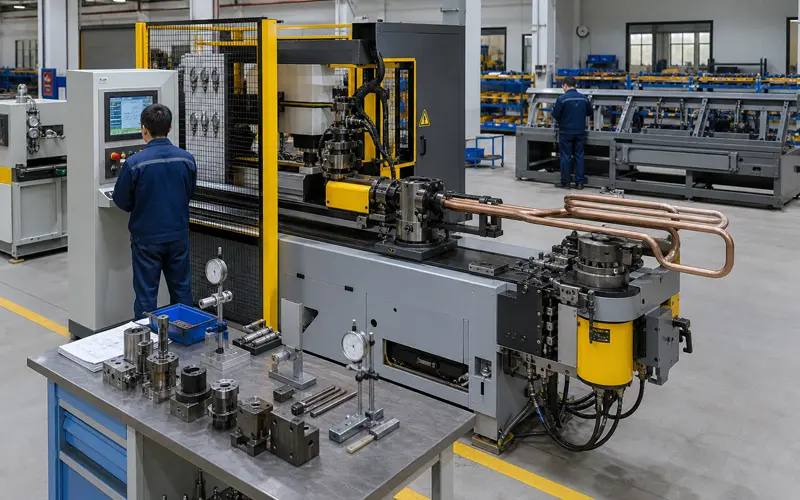
Tube bending machines cut tubes to length and bend them into shape. Two common shapes are hairpin bends and serpentine bends. A hairpin bender folds a straight tube into a U-shape for coil assembly. A serpentine bender forms one long zig-zag path from a single tube. The traits to check are bend radius and repeat accuracy. Tight, steady bends prevent cracks and keep the coil flat.
Tube Expansion (Mechanical vs. Hydraulic)
Tube expansion pushes each tube out against the fin collars. This step locks the fins and tubes together for strong heat transfer. There are two main methods, such as mechanical expansion and hydraulic expansion. Mechanical expansion, often called bullet expansion, drives a steel bullet through the tube. Hydraulic expansion uses high-pressure fluid to grow the tube. Mechanical lines cost less and run fast. Hydraulic lines give even pressure and suit thin or soft tubes.
Welding and Brazing Stations
Welding and brazing stations join the coil parts that carry fluid. These stations connect parts, such as headers, return bends, and manifolds, to the tubes. Brazing melts a filler metal, such as a copper or silver alloy, to bond the joint. Flux keeps the metal clean so the joint stays leak-free. Strong joints matter because a weak seam can leak under pressure. Careful heat control also stops the tube wall from getting thin.
Leak Testing and Quality Inspection
Leak testing and inspection form the last quality gate on the line. These checks catch defects before a coil ships. Common methods include eddy current testing, pressure decay testing, and helium leak testing. Eddy current testing finds cracks in the tube wall. Pressure decay testing watches for a slow pressure drop that signals a leak. Helium testing finds very small leaks that other methods miss. A line with strong testing keeps the scrap rate low and protects the buyer’s brand.
Single Machines vs. Integrated Production Lines: Which Do You Need?
The right choice depends on volume, labor cost, floor space, and quality needs. Single machines work well for small batches and custom jobs. They cost less up front and give the operator more control. An integrated line links every machine so parts move on their own. This setup suits high volume and standard products, such as HVAC coils, automotive condensers, and refrigerator evaporators. It cuts labor, lowers error rates, and keeps output steady. Buyers who plan to grow often choose an integrated line to avoid a second upgrade later. For this reason, Heat-Exchange.com builds both single machines and full integrated tube processing lines.
Key Technical Factors When Choosing a Production Line
Engineers judge a production line by more than its price. The best line matches the buyer’s product, output target, and materials. Four factors carry the most weight, such as throughput, material fit, fin geometry, and automation. Each one is explained below. These points separate a line that just runs from a line that runs well for years.
Production Capacity and Throughput (FPM & Meters per Minute)
Throughput shows how fast a line can work. Makers measure fin output in fins per minute (FPM). They measure tube output in meters per minute. A buyer should match these rates to a yearly target. For example, a plant that needs 500,000 coils a year needs a much faster line than a small workshop. A useful rule is to pick a line slightly above current demand. This leaves room to grow. Buyers should also check that each station runs at a matching speed. The slowest machine sets the pace, so one weak station can slow the whole line.
Material Compatibility: Copper, Aluminum, Stainless Steel, Titanium
A line must match the metals a buyer plans to run. Common tube and fin materials, such as copper, aluminum, stainless steel, and titanium, each behave in a different way. Copper bends and expands with ease. Aluminum is light but soft, so it needs gentle handling. Stainless steel and titanium are hard, so they need more force and stronger tooling. The line should include the right roll pressure, dies, and lubrication for each metal. Buyers should share their exact tube and fin materials during the first talks. This step avoids a costly mismatch after the quote.
Fin Geometry and Forming Precision
Fin shape has a direct effect on coil performance. Fin type, such as louvered, slit, wavy, or plain fins, sets the balance between heat transfer and pressure drop. Collar height and fin pitch also shape the result. A louvered fin moves more heat but adds more air resistance. A plain fin moves less heat but lets air pass with ease. The forming tools must hold tight tolerances so every fin looks the same. Steady geometry keeps coil output even across a full batch.
Automation, MES Integration, and Changeover Time
Automation raises output and lowers labor cost. Modern lines add features, such as vision inspection, MES data links, and predictive maintenance. Vision inspection spots defects that a person may miss. An MES link tracks each batch and feeds data to the plant system. Predictive maintenance warns staff before a part fails. Changeover time also matters for plants that make many coil types. A line with fast tool changes can switch products in minutes, not hours. These features suit buyers who want a smart, high-volume plant.
How to Evaluate a Chinese Production Line Supplier
Once the technical fit is clear, the next step is to judge the supplier. A strong supplier proves its skill through records, not just a low price. Buyers should review four areas, such as certifications, factory scale, performance data, and after-sales support. Each area is covered below. Together, these checks show whether a supplier can deliver on its promise.
Certifications and Standards (ISO 9001, CE)
Certifications show that a supplier follows set rules. ISO 9001 covers quality management systems. A CE mark shows that a machine meets European safety rules, which matters for buyers who ship to the EU. Buyers should confirm each certificate through an official record, not just a printed copy. A supplier that shares valid proof is easier to trust.
Factory Size and Engineering Team
Factory size and staff give clues about output and stability. A larger plant, for example one with over 10,000 square meters and 200 workers, can often handle big orders with less delay. The engineering team matters just as much. A skilled team can design custom lines and fix problems fast. Buyers should ask whether the supplier has built lines for their field, such as automotive, home appliance, or industrial coils. Proven case work in the right field lowers project risk.
Performance KPIs — On-Time Delivery, Response Time, Reorder Rate
Clear numbers show how reliable a supplier is. Three useful metrics are on-time delivery rate, response time, and reorder rate. A strong on-time delivery rate sits at 90 percent or higher. A fast response time, such as a reply within a few hours, shows good service. A high reorder rate means past buyers came back, which points to steady quality. Buyers can ask for these numbers, check platform data, or request customer references.
Samples, Trial Runs, and After-Sales Support
A full line is too large to ship as a free sample, so buyers rely on other proofs. A factory acceptance test, often called a FAT, lets the buyer watch the line run before shipment. Many suppliers also send a video of the line running the buyer’s own material. After the sale, support becomes key. Buyers should check spare part supply, remote help, and warranty terms. Strong after-sales support keeps a line running for years and protects the buyer’s investment.
Comparing Production Line Options: A Side-by-Side Example
Production lines come in tiers. The right tier depends on budget, volume, and in-house skill. The table below compares three common options, such as a budget line, a mid-tier line, and a turnkey automated line. It uses the same factors covered above, so buyers can compare them in one view.
Budget vs. Mid-Tier vs. Turnkey Line — Comparison Table
| Factor | Budget Line | Mid-Tier Line | Turnkey Automated Line |
| Throughput (FPM / m per min) | Low | Medium | High |
| Materials handled | Mainly aluminum | Copper and aluminum | Copper, aluminum, steel, titanium |
| Automation level | Semi-auto, more labor | Partly automated | Fully automated with MES |
| Certifications | Basic | ISO 9001 | ISO 9001 and CE |
| Lead time | Short | Medium | Longer (design included) |
| Spare parts and support | Limited | Standard | Install, training, remote help |
| Price range | Low | Medium | High |
| Best-fit buyer | Small batch, tight budget | Mid-volume growth | High volume, long-term plant |
This table is a general guide. Real specs change from one project to the next. Still, it gives buyers a clear frame for the next step.
How to Read the Table for Your Own Requirements
Buyers should map the table to their own needs. Four points guide the choice, such as yearly volume, budget, in-house engineering skill, and deadline. A small workshop with a tight budget may start with a budget line. A growing plant with steady orders often fits the mid-tier line. A large maker that runs many shifts and many materials gains the most from a turnkey line. Buyers with no in-house engineers also lean toward a turnkey line, since it includes setup and training. The best fit is the line that meets today’s need and leaves room for growth.
Total Cost of Ownership vs. Purchase Price
The purchase price is only part of what a line costs. Total cost of ownership, or TCO, adds every expense across the machine’s life. A wise buyer weighs TCO, not just the first quote. The two parts below show why.
Energy, Maintenance, and Downtime Costs
Three ongoing costs shape TCO, such as energy, maintenance, and downtime. Energy use varies by design. For example, a servo-driven machine often uses less power than an older hydraulic one. Maintenance covers spare parts, service visits, and worn tooling. Downtime is the hidden cost. Every hour a line sits idle, the plant loses output and money. A reliable line with good support keeps all three costs in check.
Why the Lowest Quote Isn’t Always the Best Value
A low quote can hide a high long-term cost. Cheap machines may use weak parts that fail early. Frequent breakdowns then raise repair bills and cut output. Over five to ten years, the total cost of a cheap line can pass that of a solid one. Buyers who study the return on an automated coil production line often find that quality pays back over time. The smart goal is best value, not lowest price.
Logistics, Payment, and Installation
A production line is large and heavy, so delivery needs careful planning. This stage covers shipping terms, payment steps, setup, and lead time. Clear terms here protect both the buyer and the supplier. The parts below break each one down.
Incoterms and Shipping (FOB, CIF, DDP)
Incoterms set who pays and who carries the risk during shipping. Three common terms are FOB, CIF, and DDP. Under FOB, the buyer takes over once goods load onto the ship. Under CIF, the supplier covers freight and insurance to the port. Under DDP, the supplier handles nearly everything up to the buyer’s door. Large machines also need strong, rust-proof crating for the sea trip. Buyers should agree on both the Incoterm and the packing standard in writing.
Payment Terms and Milestones (e.g., 30/40/30)
Staged payments spread risk across the project. A common plan is 30/40/30. The buyer pays 30 percent as a deposit, 40 percent when the line is built, and 30 percent after the acceptance test. Buyers should tie each payment to a clear milestone, such as the deposit, the FAT, and final shipment. This link gives the buyer leverage until the line meets its specs.
Installation, Commissioning, and Operator Training
Installation and training turn a shipped line into a working one. Many suppliers send engineers to set up the line at the buyer’s site. This step, called commissioning, tests the line under real conditions. Operator training then teaches staff how to run and maintain each machine. On-site acceptance, or SAT, confirms the line meets its targets in the buyer’s plant. Strong setup support is a core benefit of a turnkey package.
Lead Times: Standard vs. Custom Lines
Lead time depends on how custom the line is. A standard or semi-standard line often ships in about 8 to 12 weeks. A fully custom line can take four to six months, since design and approval add time. Buyers should confirm the schedule in the contract. Early talks about materials and coil design help keep the project on track.
Frequently Asked Questions
Can I visit the factory before placing an order?
Yes. Most Chinese manufacturers welcome factory visits. A visit lets buyers see the production line, meet the engineering team, and check quality controls in person. Buyers who cannot travel can request a live video tour instead. Either option builds trust before a large order.
What is the typical lead time for a heat exchanger production line?
Lead time depends on the design. A standard line often ships in about 8 to 12 weeks. A fully custom line can take four to six months, because design and approval add time. Confirming the schedule in the contract keeps the project clear.
What is the minimum order — can I buy a single machine instead of a full line?
Yes. Most suppliers sell single machines as well as full lines. A buyer can start with one machine, such as a fin press, tube bender, or expander, and add more later. This path suits small plants that plan to grow step by step.
Can the line be customized for my coil design?
Yes. Experienced suppliers design lines around a buyer’s coil specs. Custom options cover tube size, fin type, bend shape, and output speed. Buyers should share full drawings and target volumes early. Clear specs help the supplier build a line that fits the product from day one.
Conclusion: Building a Reliable Heat Exchanger Production Line
A smart purchase rests on three pillars, such as technical fit, a reliable supplier, and total cost of ownership. A line that matches the product, comes from a proven maker, and earns its cost back will serve a plant for years. Buyers who plan early and ask clear questions face far less risk. In short, sourcing a heat exchanger production line from China can bring strong value when the choice is made with care. To explore the full range of machines and lines, buyers can visit the Heat-Exchange.com homepage or share their project details through the contact page.
Want to Know More About Our Products?
View All Products Now