Pickling, Degreasing, and Drying: Pre-Brazing Cleaning for Copper-Aluminum Coils
Jump to section
A brazed joint can only form well when the filler metal reaches a clean base-metal surface. Oil, grease, oxide, dust, and cleaning residue can block that contact. They can also keep flux from spreading. Molten filler metal may then fail to move through the joint by capillary action.
Pre-brazing cleaning is therefore part of joint production, not a separate cosmetic step. For copper-tube/aluminum-fin coils, the process needs extra care. A cleaner that works on copper may attack nearby aluminum. A drying oven may remove water but leave oil behind. Pickling may remove oxide, but it cannot replace degreasing.
This guide explains each cleaning stage before coil brazing. It covers degreasing, oxide removal, rinsing, drying, clean handling, and process checks.
Why Is Pre-Brazing Cleaning Critical for Copper-Aluminum Coils?
Pre-brazing cleaning exposes a stable metal surface for flux and filler metal. Clean surfaces support wetting, capillary flow, and consistent joint fill. Poor cleaning can lead to voids, residue, poor appearance, or leaks. The effect depends on the type and location of the contamination.
How Oil, Oxides, Particles, and Moisture Disrupt Brazing
Oil and grease form a barrier over the metal. When heated, they may burn or leave carbon-like residue. Flux can pull away from these areas, and filler metal may not wet them.
Oxides create another barrier. Copper and aluminum both form oxides, but their cleaning needs differ. A qualified flux may manage light residual oxide. Heavy oxide or heat tint may need chemical or mechanical removal first.
Dust, chips, abrasive particles, and dried cleaner can block filler flow. Moisture may dilute water-based flux or remain trapped in tube ends and coil gaps.
Why Flux Cannot Replace Proper Surface Cleaning
Flux controls residual oxides during heating and protects the surface from further oxidation. It is not designed to remove thick grease, dirt, chips, or heavy scale. Adding more flux to a dirty joint may increase residue without fixing the cause. Bulk contamination must be removed first.
What Must Be Checked Before Cleaning a Copper-Aluminum Coil?
The plant must identify the actual joint material, contamination, and cleaning limits. “Copper-aluminum coil” can describe more than one construction, and those constructions do not share one cleaning recipe.
Copper-Tube/Aluminum-Fin Coils vs. Copper-to-Aluminum Joints
A common HVAC coil has copper tubes and aluminum fins. Its brazed return bends or headers may still be copper-to-copper. Local cleaning can therefore focus on copper, but nearby aluminum fins must remain protected.
A direct copper-to-aluminum joint has different oxide behavior and thermal response. Its cleaner, filler metal, flux, heat source, and joint design must be qualified together. Full-coil immersion also needs trials because chemistry can reach the fins, tube passages, and narrow spaces.
Identify the Contaminant and Its Source
Common contamination sources include:
- Drawing, forming, stamping, or storage oils
- Fingerprints and shop dirt
- Copper or aluminum oxides
- Chips and particles from cutting or brushing
- Cleaner residue or water trapped in tube ends and fin gaps
The lubricant supplier should identify the oil type. It may be mineral-based, water-soluble, synthetic, silicone-containing, or designed to evaporate. One cleaner may not remove every type.
Confirm Material, Flux, and Process Compatibility
The cleaning plan should list every material that can touch the cleaner. This list includes tubes, fins, headers, end plates, coatings, and fixtures. Concentration, temperature, contact time, agitation, and rinsing should come from supplier data and plant trials. The part must also drain and dry fully, including blind spaces and tube passages.
What Is the Correct Pre-Brazing Cleaning Sequence?
The normal sequence removes oil first. It removes oxide next when needed, then rinses and dries the part. Clean parts should be protected and moved to fluxing and brazing within a controlled time.
The full sequence is:
Incoming inspection → Degreasing → Rinsing → Oxide removal when required → Final rinsing → Drying → Clean handling → Fluxing and brazing
| Stage | Main target | Key control | Risk if skipped |
| Incoming inspection | Unknown soils or material changes | Material lot, lubricant, oxide level, joint location | Wrong cleaner or process setting |
| Degreasing | Oil, grease, fingerprints, forming fluid | Cleaner compatibility, concentration, time, temperature | Poor flux coverage and filler wetting |
| First rinse | Used cleaner and loose soil | Coverage, carryover, drainage | Cleaner moves into the next bath |
| Oxide removal | Oxide or scale that the flux cannot manage | Qualified chemical or mechanical method | Incomplete wetting and joint fill |
| Final rinse | Acid, alkali, particles, dissolved salts | Rinse-water condition and complete drainage | Residue, staining, or corrosion risk |
| Drying | Surface and trapped water | Part orientation, airflow, time, temperature | Moisture enters fluxing or brazing |
| Clean handling | Dust, body oils, shop contamination | Gloves, racks, covers, maximum hold time | Recontamination before brazing |
The order should change only under a qualified process. Pickling cannot replace degreasing because oil can shield the metal and cause uneven oxide removal.
How Should Copper-Aluminum Coils Be Degreased Before Brazing?
The degreasing method must match the lubricant and every exposed metal. Aqueous, solvent, and thermal methods have different limits. Soil type, part geometry, production volume, and the later brazing process all matter.
Aqueous Cleaning for Water-Soluble and Mixed Shop Soils
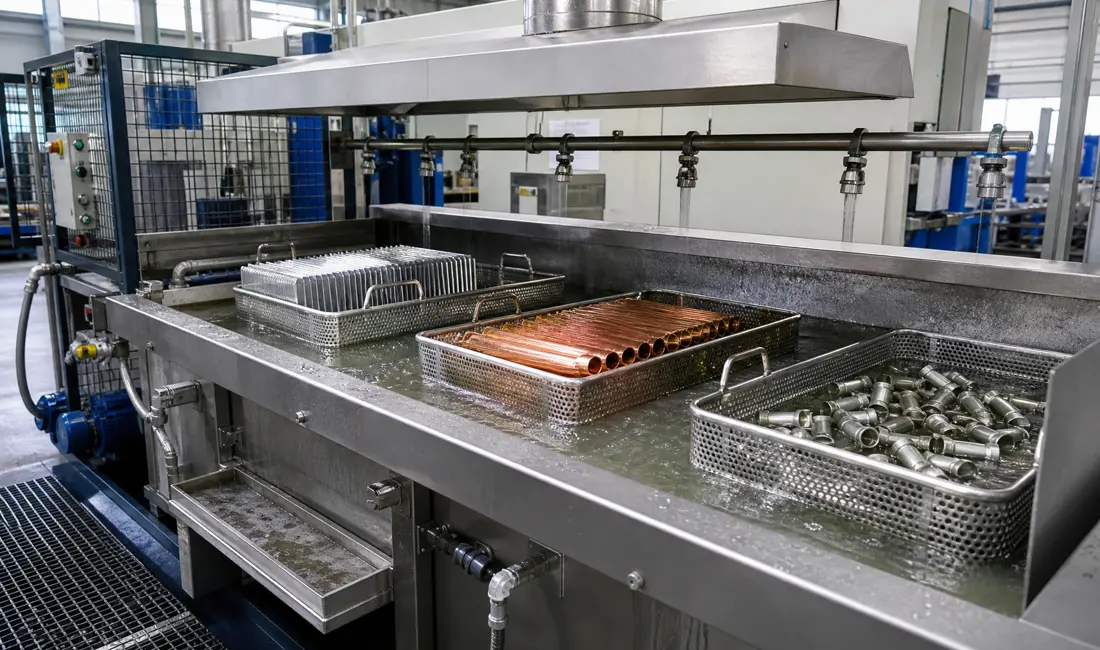
Aqueous cleaning uses water with detergents, surfactants, and other active ingredients. Spray or immersion can remove water-soluble fluids and mixed dirt. The chemistry must be approved for both copper and aluminum.
The plant should control concentration, temperature, contact time, agitation, filtration, and loading. A weak bath may leave oil. An overly strong or hot bath may stain or etch aluminum. Nozzle position and part orientation should be tested on the real coil. Cleaner must reach deep rows and then drain away.
The cleaner must be rinsed off and should not dry on the part.
Solvent Cleaning for Compatible Oils and Local Joint Areas
Solvent cleaning can suit certain oils and exposed joint areas. It may use controlled wiping, approved immersion, or a closed vapor system. The solvent must dissolve the actual lubricant without leaving a film.
Local wiping can work on a copper return bend or tube end, but a dirty cloth may spread oil. Cleaning material should be clean and low-lint. Fire, ventilation, exposure, storage, and environmental rules also affect solvent choice. Fast evaporation alone does not prove cleanliness.
When Thermal Degreasing Is—and Is Not—Suitable
Thermal degreasing works only with lubricants designed to evaporate cleanly. Qualified vanishing oils used in some fin-forming operations are one example. Ordinary drawing oil or an unknown lubricant may break down and leave a carbon film.
Thermal degreasing also differs from drying. A dryer removes water from an already clean part. A thermal degreaser removes a qualified volatile oil through a validated time-temperature cycle.
When Is Pickling Needed Before Brazing?
Pickling removes oxide or scale after degreasing. It is not required for every copper part and is not a universal treatment for a mixed-metal coil. The process should remove only what is needed; stronger chemistry or longer immersion is not automatically better.
Pickling Copper Surfaces Before Brazing
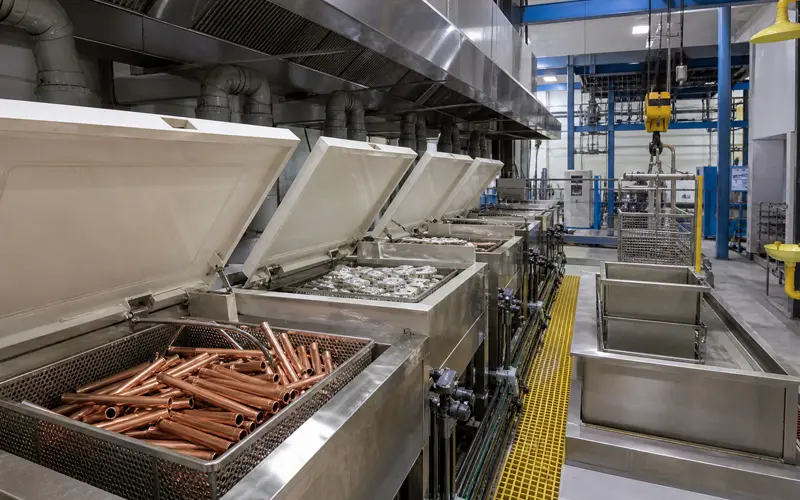
Fresh copper with a light, clean surface may need little oxide removal. Stored, heat-tinted, or visibly oxidized copper may need a qualified pickle or local mechanical cleaning.
Chemical pickling requires control of concentration, temperature, contact time, bath loading, and surface loss. The part must then be rinsed well. Acid left in tube ends or gaps can create residue and corrosion. One formula should not be copied across copper grades, brass parts, coatings, or complete coils.
Why Aluminum and Mixed-Metal Assemblies Need Different Chemistry
Strong acids and strong alkaline cleaners can attack aluminum under the wrong conditions. Thin fins may etch or stain before the copper tube looks affected. Local copper-joint cleaning is often easier to control than full immersion.
If full-core cleaning is required, trials should use the complete material stack. Checks should cover fin condition, tube surface, coatings, trapped solution, rinse quality, braze response, and corrosion performance.
When Mechanical Oxide Removal Is the Safer Option
Mechanical cleaning can remove light oxide from an exposed joint without placing the full coil in acid. A dedicated stainless-steel brush or another approved tool may be used.
The tool must be clean and reserved for the process. Abrasive particles can become embedded, and too much force can scratch thin tube. The result should be a sound surface rather than deep marks, with loose particles removed before fluxing.
Why Do Rinsing and Drying Matter Before Brazing?
Rinsing removes the cleaning chemistry, while drying removes retained water. Both steps are needed after wet cleaning. Neither one can correct oil or oxide that was left on the part earlier.
Coils are harder to rinse and dry than simple tube coupons. Their fins, collars, end plates, and tube passages create many places where liquid can remain.
Final Rinse Water Quality and Coil Drainage
Final rinse water should meet the plant’s process specification and should not add harmful mineral or chemical residue. Many controlled processes monitor conductivity, pH, or another rinse-water measure. The correct limit depends on the brazing method, flux, alloy, and customer requirement.
Rinse coverage should reach the same areas as the cleaner. Part orientation should let liquid leave the coil. It should not collect near end plates or inside open tube ends. Air knives, tilting, rotation, or a controlled air purge may help. Each method should be validated for the real part.
Deionized or reverse-osmosis water can reduce mineral carryover in demanding processes. It should not be stated as mandatory for every coil unless the approved specification requires it.
Drying After Aqueous Cleaning or Pickling
Drying may use filtered forced air, an oven, or both. The process should remove water from visible surfaces and hidden areas without overheating the coil or causing new oxidation.
Time and temperature alone do not prove dryness. A densely packed coil may need a different orientation or airflow path from a single tube. Tube ends, return-bend sockets, header openings, and spaces beside end plates should be checked during process trials.
“Dry to the eye” is not a complete acceptance rule. A cool area inside the coil can still hold water after the outside appears dry. The process should define how dryness is checked. It should also set the allowed wait before fluxing or brazing.
Post-Flux Dry-Off Is Not the Same as Degreasing
In some aluminum controlled-atmosphere brazing lines, a water-based flux is applied after degreasing. A dry-off oven then removes the water carrier before the core enters the brazing furnace.
This stage is not a substitute for cleaning. If ordinary oil remains under the flux, drying the water may leave the oil in place. The same rule applies to a copper-aluminum coil. Its surface must be clean before flux application. Any later dry-off step should only perform its approved job.
How Is Pre-Brazing Cleanliness Verified?
Pre-brazing cleanliness is best verified with several checks. Quick surface tests show the current condition, while process records reveal drift. Trial brazes and joint analysis confirm whether the cleaning method supports the final product.
The control plan should be simple enough for production use but detailed enough to trace a change.
Practical Surface and Dryness Checks
A clean white wipe can reveal loose dirt, oil, or dark residue on an exposed surface. It is fast, but it only checks the area touched by the wipe.
A water-break test may be useful on suitable test surfaces. Water that forms a stable sheet can suggest that oil has been removed. Water that pulls into beads or breaks away may point to organic contamination. This test does not prove that oxide is gone. It also cannot confirm chemical compatibility or full-coil dryness.
Visual inspection can find stains, etching, heavy oxide, brush marks, or dried cleaner. Drainage and air-purge checks can help identify trapped water. When the risk is high, a sample joint, section, residue test, or other approved laboratory method may be needed.
Process Parameters That Should Be Recorded
A useful production record may include:
- Part number and material lot
- Lubricant or forming-fluid identity
- Cleaner identity, batch, and concentration
- Bath temperature and contact time
- pH where relevant
- Rinse-water condition
- Dryer temperature, airflow, and conveyor speed
- Cleaning completion time
- Maximum clean-to-braze hold time
- Operator, line, and shift
These records help explain a sudden rise in brazing defects. A change in lubricant, fin supplier, tube coating, cleaner, bath loading, or conveyor speed may matter. This remains true when the brazing machine settings have not changed.
Clean Handling and Storage Before Brazing
Clean parts can become dirty again within minutes. Operators should use clean gloves and approved racks. Cleaned joints should not be placed on oily tables. They should also stay away from grinding dust, silicone products, sprays, and open shop traffic.
Covered containers or protected transfer carts can reduce dust and hand contact. The plant should set a maximum hold time based on material, humidity, storage conditions, and braze results. Parts held longer than this limit should be reinspected and, when required, recleaned.
Which Cleaning Defects Cause Common Brazing Problems?
Cleaning defects often appear as wetting, residue, appearance, or fill problems. However, the same symptom can come from joint clearance, filler placement, flux, heating, atmosphere, or fixturing. Troubleshooting should check the whole process.
| Observed problem | Possible cleaning cause | What to check first |
| Filler metal beads up or does not spread | Oil, oxide, dried cleaner, or wrong surface preparation | White-wipe result, oxide level, degreasing method, final rinse |
| Flux pulls away from part of the joint | Local oil film, handling mark, or incompatible residue | Joint-area cleanliness and glove handling |
| Black or carbon-like deposit appears | Ordinary oil entered thermal degreasing; organic residue remained | Lubricant type and time-temperature cycle |
| Joint has voids or incomplete fill | Dirt, oxide, trapped particles, or moisture | Cleaning sequence, joint interior, rinse and drying records |
| Aluminum fins are etched or stained | Cleaner too strong, contact too long, poor rinse, or incompatible chemistry | Cleaner approval, concentration, temperature, and exposure time |
| Liquid remains in tube ends or coil gaps | Poor orientation, blocked drainage, weak airflow, or short drying time | Part position, drain path, purge, and dryer validation |
| Rejects rise after a process change | New lubricant, material lot, cleaner condition, or line speed | Change records and first affected production lot |
A passed leak test does not prove that cleaning was ideal. A joint may seal but still contain excess residue or poor local fill. A clean-looking surface also has limits. It does not prove that the joint clearance or heating cycle is correct.
How Can Manufacturers Choose a Pre-Brazing Cleaning Process?
The right process depends on the joint material, soil level, production volume, part shape, rinse access, environmental limits, and brazing method. Local cleaning may suit exposed copper joints. A high-volume line may need several controlled spray and drying zones.
Equipment selection should begin with the part and process data, not with a preferred cleaning technology.
Local Cleaning for Torch- or Induction-Brazed Copper Joints
Local cleaning can suit copper return bends, headers, and tube ends that remain accessible before brazing. The station may combine controlled degreasing, approved oxide removal, residue removal, inspection, and protected transfer to the brazing cell.
Plants may use a continuous condenser and evaporator flame brazing line for copper tubes, copper elbows, and brazing rings. These cleaning controls belong before line loading. The brazing line can deliver controlled heat, but it cannot remove oil or oxide trapped inside an assembled joint.
The layout should also prevent cleaned parts from crossing dirty forming or cutting areas on the way to brazing.
In-Line Aqueous Cleaning for High-Volume Coil Production
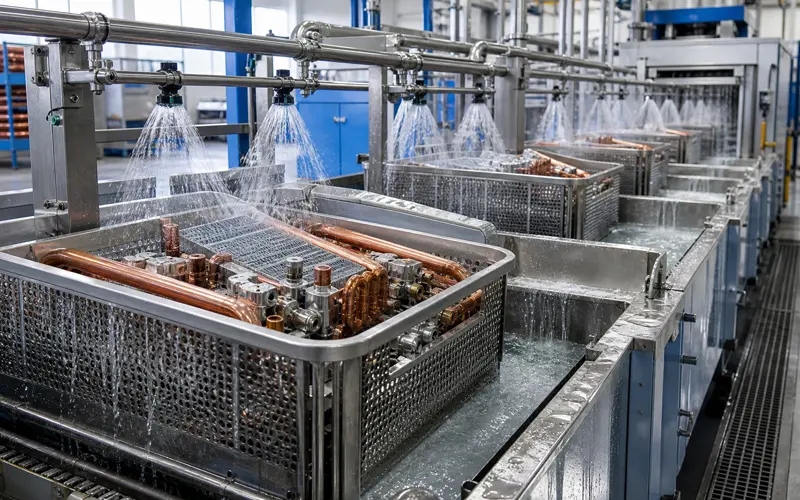
A high-volume aqueous line may include prewash, wash, one or more rinses, air blow-off, and an oven. Filtration and bath monitoring help keep removed oil from returning to later parts.
The line should be designed around actual coil depth, fin density, tube position, and drainage path. Conveyor speed sets the contact and drying time. Nozzles, part carriers, air knives, and oven airflow should be tested at the highest planned loading.
Wastewater, ventilation, chemical storage, bath maintenance, and operator access are part of equipment selection. A fast cleaning cycle has little value if it creates residue, corrosion, or high reject rates.
Thermal Degreasing and Dry-Off in an Aluminum CAB Line
An all-aluminum CAB line often follows a different route. A typical system can include thermal degreasing, flux application, dry-off, and furnace brazing in a controlled atmosphere. This works when the aluminum materials, lubricants, flux, and furnace cycle are designed as one process.
That sequence should not be copied automatically to a copper-tube/aluminum-fin coil. The coil may use flame-brazed copper joints rather than furnace-brazed aluminum joints. The correct route depends on what is being joined, not only on the visible fin material.
Frequently Asked Questions About Pre-Brazing Coil Cleaning
The following questions cover handling and verification. These issues often appear after the main cleaning method has been selected.
Can Cleaned Coil Parts Be Stored Overnight Before Brazing?
They can only be stored when the approved process allows it. Clean copper can oxidize again, while open parts can collect dust, moisture, and fingerprints. Storage time also depends on humidity, packaging, and surface condition.
The plant should define a maximum clean-to-braze interval. Parts stored beyond that period should be reinspected and recleaned when the control plan requires it.
How Should Cleaning Fluid Be Kept Out of Internal Tube Passages?
The method depends on the part. Options may include approved plugs, local cleaning, controlled orientation, and limited spray direction. Drainage time and filtered air purging may also help.
Any plug or mask must resist the cleaner and should not leave residue. The process should also confirm that fluid did not pass behind the plug or remain in a low point.
Is a Water-Break Test Enough to Approve a Coil for Brazing?
No. A water-break test can indicate some oil or organic contamination on a suitable exposed surface. It does not confirm oxide removal, hidden-joint cleanliness, chemical compatibility, rinse quality, or dryness inside the coil.
It works best as one check within a larger control plan.
Conclusion: Reliable Brazing Starts With a Material-Specific Cleaning Process
Reliable pre-brazing cleaning follows a clear rule. The plant must identify the materials and soil, then remove oil first. It should remove oxide only when needed. It must then rinse away the chemistry, dry all areas, and protect the part until brazing. Each step should be tied to controlled process data and final joint results.
There is no universal acid bath, degreaser, or drying cycle for every copper-aluminum coil. The correct solution depends on the actual joint, nearby materials, production rate, cleaning access, and brazing method.
Manufacturers planning tube processing, cleaning integration, or brazing cells can contact BOBO Machine. A process review can cover coil drawings, materials, output targets, and line layout. It can then define which operations should be local, automated, or part of a custom production route.
Want to Know More About Our Products?
View All Products Now