Quality Inspection of Finned Tubes: Eddy Current Testing, Pressure Decay & Helium Leak
Jump to section
Quality inspection of finned tubes catches defects before a coil ships. Three tests do most of this work, such as eddy current testing, pressure decay testing, and helium leak testing. Each one finds a different kind of fault at a different level of detail.
This guide explains how each test works, what it catches, and where it fits. It is written for buyers, such as coil makers, quality engineers, and procurement teams. The goal is to help a plant pick the right test, or mix of tests, for its finned tubes.
Why Finned Tube Quality Inspection Matters
A small defect in a finned tube can cause a large failure later. A tiny crack or pinhole may leak refrigerant or fluid once the coil runs under pressure. A leak lowers efficiency, raises energy use, and can void a warranty. Poor fin contact also cuts heat transfer, which weakens the whole unit. Inspection finds these faults before the coil leaves the plant. Good testing protects both the buyer’s cost and the buyer’s brand. It also lowers the risk of costly field returns. In regulated markets, buyers may also require tests that follow recognized standards, which makes solid inspection a must, not a choice.
Common Defects in Finned Tubes
Most finned tube faults fall into a few groups, such as cracks, pinholes, and weak joints. A crack may form during bending or expansion. A pinhole is a tiny hole in the tube wall that leaks slowly. A weak braze or weld joint can open under pressure. Thin tube walls, caused by over-expansion, can fail early too. Poor fin-to-tube contact lowers heat transfer without any leak at all. Each defect calls for the right test, which the next sections explain.
Eddy Current Testing (ECT)
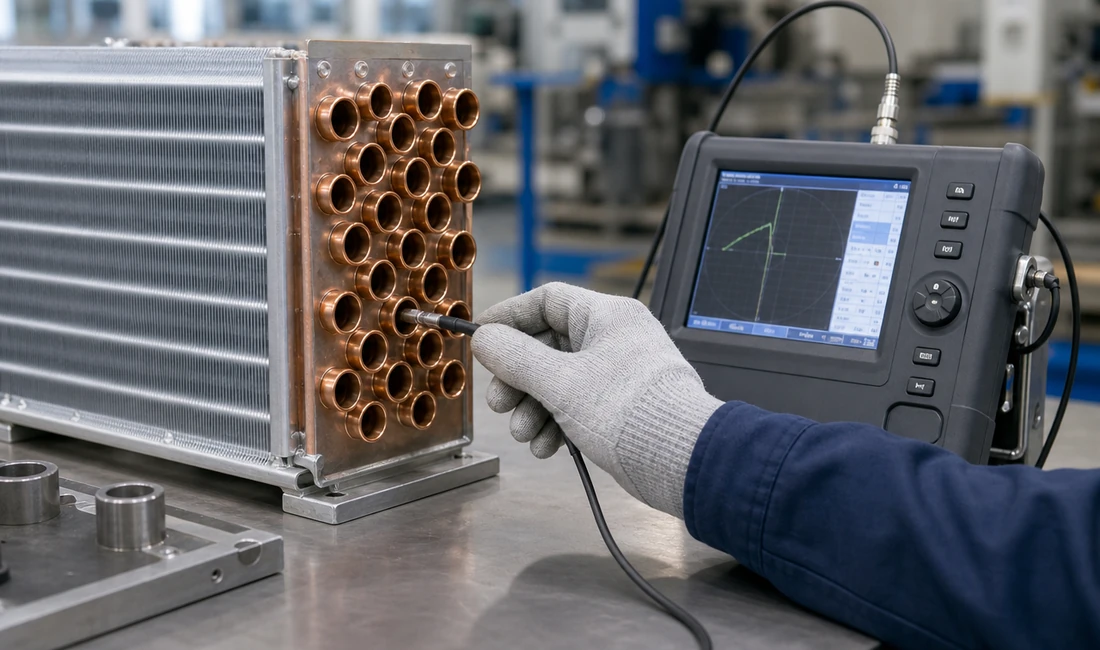
Eddy current testing is a fast, non-contact way to scan a tube wall for flaws. It suits a moving line, since it needs no fluid and no direct touch. The two parts below explain how it works and what it can and cannot find.
How Eddy Current Testing Works
Eddy current testing uses a magnetic field to read a tube wall. A probe sends an alternating current through a coil, which creates a magnetic field. This field forms small electric currents, called eddy currents, in the metal tube. A flaw in the wall disturbs these currents. The probe reads the change and flags the spot. The whole check takes only a moment per tube.
What It Detects and Its Limits
Eddy current testing finds surface and near-surface flaws in metal tubes. It catches faults, such as cracks, pinholes, and wall thinning, with good speed. It works on conductive metals, such as copper, aluminum, and stainless steel. But it has limits. It reads best near the surface, so deep flaws are harder to find. It also needs a reference standard to set the pass and fail lines. Even so, its speed makes it a strong first check on a production line.
Pressure Decay Testing
Pressure decay testing checks a whole tube for leaks with clean, dry gas. It is simple and low in cost, so many plants use it as a standard leak check. The two parts below cover how it works and where it fits.
How Pressure Decay Testing Works
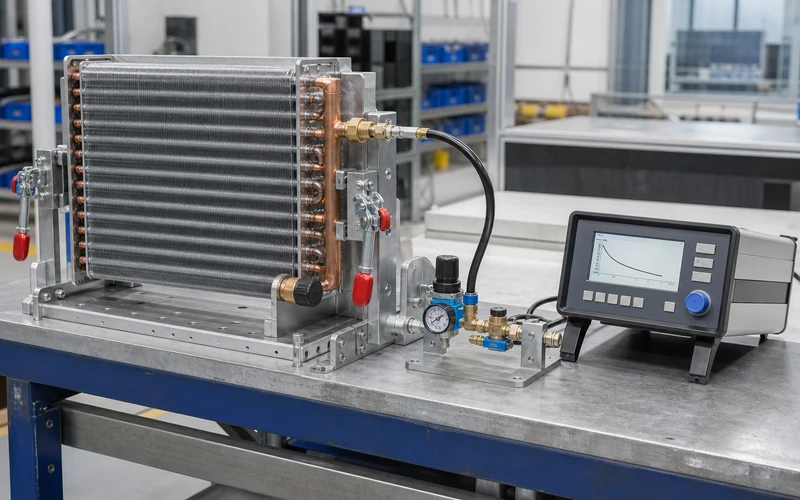
Pressure decay testing watches pressure over time to spot a leak. The plant fills the tube with air or nitrogen to a set pressure. It then seals the tube and holds it for a fixed time. A sensor watches the pressure the whole time. If the pressure drops, the tube has a leak. A steady pressure means the tube is sound.
What It Detects and Its Limits
Pressure decay testing finds gross and mid-size leaks well. It can sense a leak rate down to about 10⁻³ to 10⁻⁴ mbar·L/s in many setups. This range suits most standard coils, such as HVAC coils, condenser coils, and radiator coils. But it cannot find very tiny leaks. Temperature swings can also skew the reading, so the test needs stable conditions. For most plants, it offers a fast, low-cost leak check on the line.
Helium Leak Testing
Helium leak testing is the most sensitive of the three methods. It finds leaks far too small for the other tests to catch. The two parts below explain how it works and when it is worth the extra cost.
How Helium Leak Testing Works
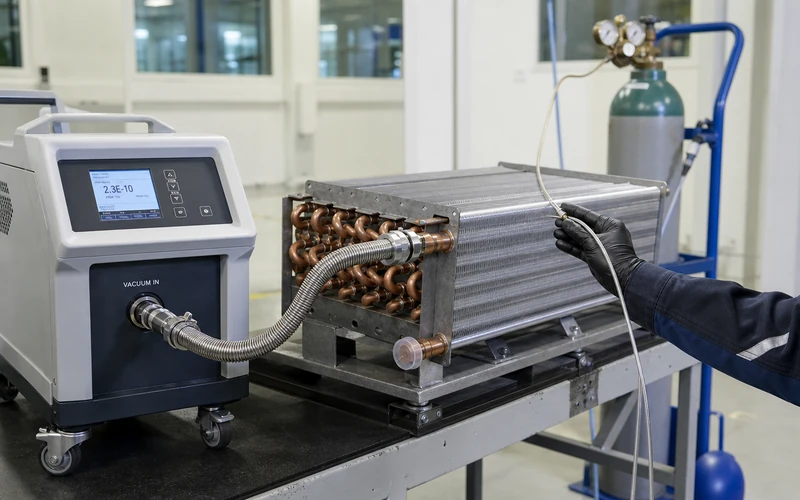
Helium leak testing uses helium gas to find very small leaks. Helium is a small, light atom that slips through tiny gaps. The plant fills or surrounds the tube with helium. A tool called a mass spectrometer then sniffs for escaping helium. Even a trace of helium points to a leak and shows its size. This method reaches a level of detail the other tests cannot match.
What It Detects and Its Limits
Helium leak testing finds leaks far smaller than the other tests. It can sense a leak rate down to about 10⁻⁹ mbar·L/s, which is thousands of times finer than pressure decay. This power suits tight, critical parts, such as refrigerant coils, sealed systems, and vacuum units. But the test costs more and runs slower. It also needs helium gas and special tools. Plants often save it for high-value or safety-critical coils.
Comparing the Three Methods
The table below sets the three tests side by side. It shows what each one finds, how sensitive it is, and where it fits best.
| Factor | Eddy Current Testing | Pressure Decay Testing | Helium Leak Testing |
| What it finds | Cracks, pinholes, wall thinning | Gross to mid-size leaks | Very small leaks |
| Sensitivity | Surface and near-surface flaws | ~10⁻³ to 10⁻⁴ mbar·L/s | ~10⁻⁹ mbar·L/s |
| Speed | Very fast | Fast | Slower |
| Cost | Low to medium | Low | Higher |
| Best fit | Inline wall scan | Standard coil leak check | Critical or sealed coils |
| Main limit | Reads best near surface | Misses tiny leaks | Cost and cycle time |
This table is a general guide. Real limits depend on the tube, the probe, and the test setup.
Other Inspection Checks to Know
The three main tests are not the only checks a plant can use. A few more methods add extra coverage, such as visual inspection, dimensional checks, and bubble testing. Visual inspection catches obvious faults, such as dents, scratches, and loose fins, with a trained eye or a camera. Dimensional checks confirm the tube size, fin pitch, and bend angle against the spec. A bubble test submerges a pressured tube in water and watches for rising bubbles, which mark a leak. A hydrostatic test fills the tube with water at high pressure to prove its strength. These checks often run alongside the three main tests for a complete quality plan.
How to Choose the Right Inspection Method
The right test depends on the coil and how tight it must seal. A buyer should look at the application, the pressure, and the allowed leak rate. The two parts below give a clear rule.
Match the Method to the Application
Each test fits a certain need. Eddy current testing suits a fast, inline scan for wall flaws. Pressure decay testing suits standard coils that need a basic leak check. Helium leak testing suits tight parts, such as refrigerant lines, medical units, and vacuum systems. A buyer should map the test to the coil’s real duty. The tighter the seal must be, the more sensitive the test should be.
Combining Methods for Full Coverage
Many plants use more than one test for full coverage. A common flow runs a fast eddy current scan first to catch wall flaws. A pressure decay test then checks the whole tube for leaks. A helium test follows only for the most critical coils. This layered plan catches both large and tiny faults. It also keeps cost in check, since the slow helium test runs on fewer parts.
Building Inspection into the Production Line
Strong plants build inspection into the production line itself. Inline tests check each coil as it moves, so faults show up right away. This approach lowers the scrap rate and speeds up rework. The two parts below explain how to set it up and how to use the data.
Inline vs Offline Testing
Inspection can run inline or offline, and each has a place. Inline testing sits inside the line, so it checks every coil as part of the flow. It gives fast feedback and catches faults early, which suits high volume. Offline testing runs at a separate station, away from the line. It fits slow, detailed tests, such as helium checks on critical coils. Many plants use inline tests for speed and offline tests for depth. The right mix depends on volume and the leak rate the coil must meet.
Using Test Data to Improve Quality
Test data does more than pass or fail a coil. Automated stations, such as eddy current scanners, pressure test rigs, and vision cameras, record each result. This data feeds the plant system, where it shows trends over time. A rise in one fault, such as cracks at a bend, points to a root cause upstream. The team can then fix the tool or setting before more coils fail. Quality finned tube machinery can include these test stations and data links as part of the line.
Frequently Asked Questions
What is the most sensitive leak test for finned tubes?
Helium leak testing is the most sensitive. It can find leaks as small as about 10⁻⁹ mbar·L/s, far finer than pressure decay. This makes it the top choice for tight, critical coils. Its higher cost means plants often use it only where needed.
Can eddy current testing find all defects?
No. Eddy current testing is fast and finds many wall flaws, such as cracks, pinholes, and thinning. But it reads best near the surface and can miss deep or hidden faults. It also does not measure a full leak rate. Most plants pair it with a leak test for full coverage.
How small a leak can helium testing detect?
Helium testing can sense leaks down to about 10⁻⁹ mbar·L/s in many setups. That is thousands of times smaller than a pressure decay test can find. This power suits sealed and refrigerant coils. The exact limit depends on the tool and the method used.
Should a plant use more than one test?
Often, yes. One test rarely catches every kind of fault. A common plan runs eddy current, pressure decay, and helium tests in layers. This mix catches both wall flaws and tiny leaks. It also controls cost by saving the slow test for critical parts.
Conclusion: Ensuring Reliable Finned Tube Quality
Reliable finned tube quality rests on the right tests, used in the right order. Eddy current testing scans the wall for flaws. Pressure decay testing checks for standard leaks. Helium leak testing catches the smallest leaks in critical coils. Together, these methods protect efficiency, safety, and the buyer’s brand. A plant that builds testing into its line ships fewer bad coils and earns more trust. To see finned tube machinery with built-in inspection, buyers can explore the finned tube machinery range or share their quality needs through the contact page.
Want to Know More About Our Products?
View All Products Now