Shell-and-Tube vs Plate vs Fin-and-Tube Heat Exchangers: A Complete Comparison
Jump to section
Choosing between shell-and-tube, plate, and fin-and-tube heat exchangers starts with the heat transfer duty. There is no single design that is best for every system.
Shell-and-tube heat exchangers are widely used for demanding process duties, especially when pressure, temperature, fluid volume, or service life is important. Plate heat exchangers offer strong heat transfer in a compact size and are often used for liquid-to-liquid duties. Fin-and-tube heat exchangers are a common choice when air or another gas is on one side of the heat transfer process.
The right choice also depends on factors such as fluid type, pressure drop, fouling, installation space, cleaning needs, and total operating cost. These factors matter more than thermal efficiency alone.
This guide compares the three designs from an engineering, purchasing, and manufacturing point of view.
Shell-and-Tube vs Plate vs Fin-and-Tube: Quick Comparison
The main difference is the way each design creates heat transfer area and handles the two heat transfer media.
| Criteria | Shell-and-Tube | Plate | Fin-and-Tube |
| Basic structure | Tube bundle inside a shell | Thin plates with flow channels | Tubes combined with external fins |
| Common media | Liquid-liquid, steam-liquid, process fluids | Mainly liquid-liquid; some two-phase duties | Liquid/refrigerant-to-air or gas |
| Heat transfer performance | Good and highly flexible | High for many clean liquid duties | High air-side area due to fins |
| Pressure and temperature range | Well suited to many demanding process duties | Depends strongly on gasketed, brazed, or welded design | Depends mainly on tube, joint, and material design |
| Equipment size | Usually larger | Usually compact | Depends on airflow and required coil face area |
| Fouling tolerance | Can suit dirtier fluids with proper tube and shell design | Narrow channels require careful fluid selection | Air-side dust, frost, and debris can reduce performance |
| Cleaning | Mechanical or chemical cleaning may be possible | Gasketed units can be opened; other designs may use CIP | Tube and fin surfaces require regular inspection |
| Main energy concern | Pumping pressure drop | Pumping pressure drop | Fluid pressure drop plus fan power |
| Common uses | Chemical plants, power systems, oil processing, industrial heating | HVAC water loops, heat recovery, food processing, industrial cooling | HVAC, refrigeration, heat pumps, condensers, evaporators |
| Main strength | Rugged and flexible design | Compact and thermally efficient | Effective air-side heat transfer |
These are general differences rather than fixed rules. The final performance depends on exchanger size, materials, channel geometry, flow rate, and operating conditions.
How Do the Three Heat Exchanger Designs Work?
Each design moves heat between two media without requiring them to mix. The main difference is the surface that separates the hot and cold sides.
How a Shell-and-Tube Heat Exchanger Works
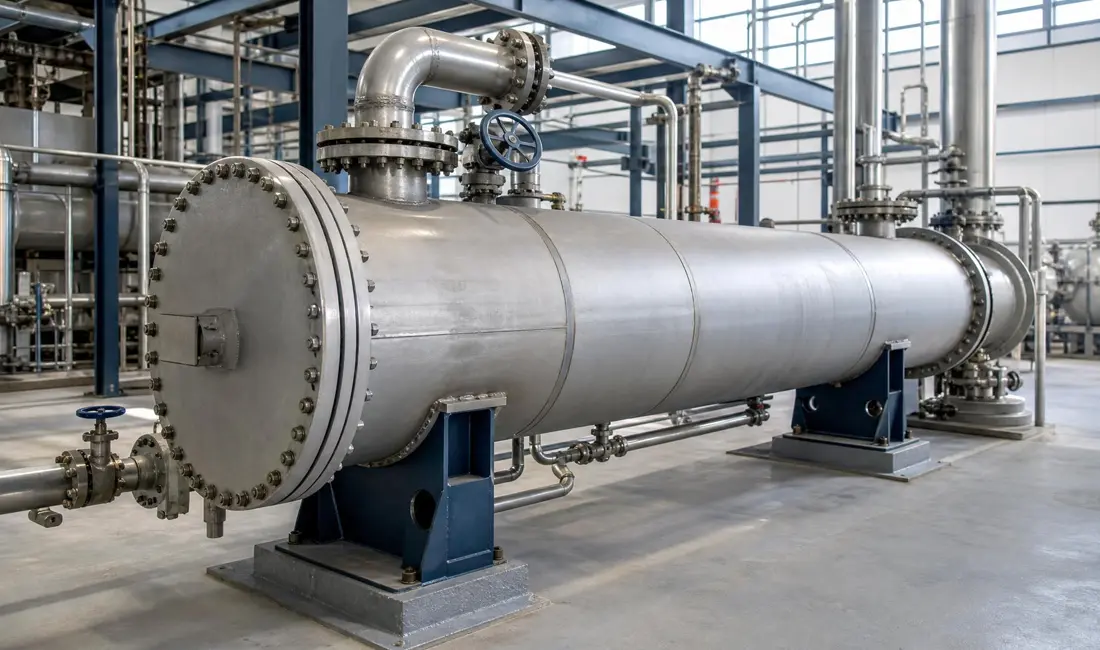
A shell-and-tube heat exchanger uses a group of tubes placed inside a larger outer shell.
One fluid flows through the tubes. The second fluid flows around the outside of the tubes but remains inside the shell. Heat passes through the tube wall.
Baffles may be installed inside the shell to guide the shell-side fluid across the tube bundle. They can improve fluid movement and support the tubes.
Shell-and-tube units can use different layouts, such as straight tubes, U-tubes, single-pass arrangements, and multi-pass arrangements. This gives engineers many ways to adjust pressure drop, heat transfer area, and cleaning access.
This type remains common in industrial process systems because the basic structure is strong and can be adapted to many operating conditions.
How a Plate Heat Exchanger Works
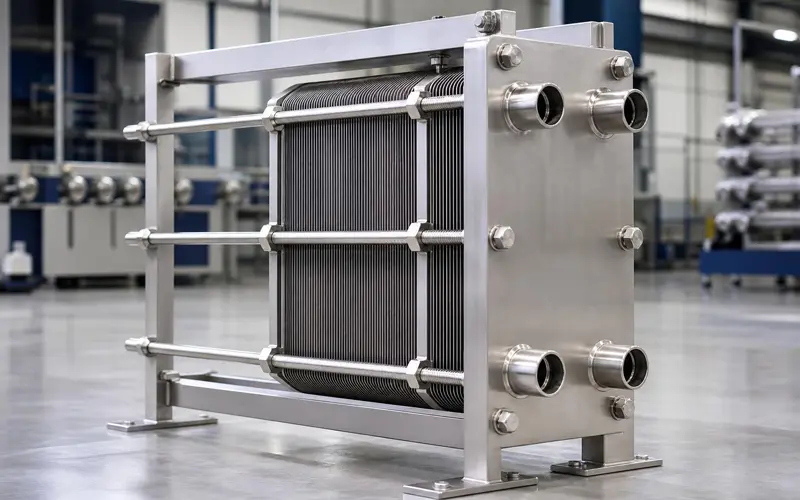
A plate heat exchanger transfers heat through a stack of thin metal plates.
The plates create separate channels for the hot and cold fluids. In many designs, the two fluids move in opposite directions. This counter-current arrangement helps maintain a useful temperature difference across the exchanger.
Corrugated plate surfaces also create turbulence. This can improve heat transfer while keeping the unit compact.
Plate heat exchangers come in several forms. Three common examples are gasketed plate-and-frame units, brazed plate heat exchangers, and welded plate heat exchangers.
The construction method is important. A gasketed unit can often be opened for cleaning or capacity changes. A brazed or welded design is more compact and sealed, but it has a different maintenance method.
How a Fin-and-Tube Heat Exchanger Works
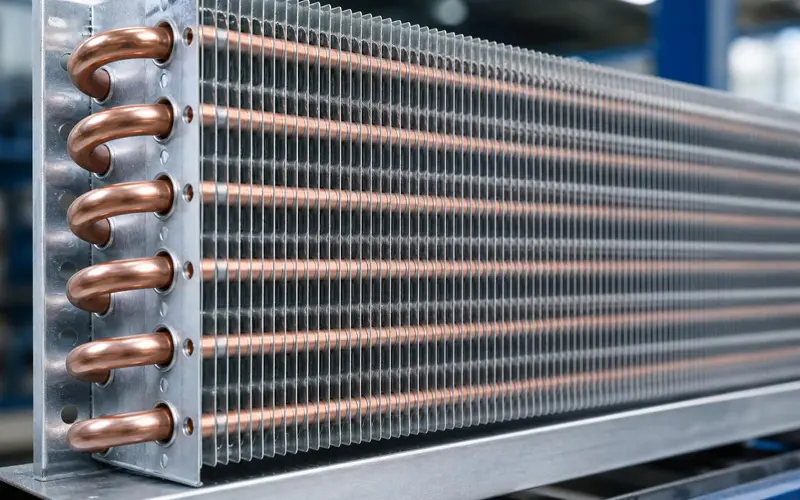
A fin-and-tube heat exchanger uses tubes to carry a fluid and fins to increase the outside heat transfer area.
The tube-side medium may be refrigerant, water, oil, or another fluid. Air or gas flows across the fins and tubes.
The fins are important because air usually transfers heat less effectively than liquids. Adding fins gives the air side much more surface area without requiring the same increase in tube length.
This design is common in equipment such as air conditioners, refrigeration systems, heat pumps, air coolers, condensers, and evaporators.
Fin shape and spacing also affect performance. More fin area can improve heat transfer, but very close fin spacing may increase airflow resistance and make fouling, frost, or condensate drainage more important. ASHRAE notes that fin spacing is selected with factors such as fouling, frost formation, drainage, cost, weight, and volume in mind.
Shell-and-Tube vs Plate vs Fin-and-Tube: Key Differences
The best way to compare these heat exchangers is by the conditions that affect real system performance.
Heat Transfer Efficiency and Temperature Approach
Plate heat exchangers often provide strong thermal performance in a small space, especially for clean liquid-to-liquid duties.
Their thin plates create a short path for heat to move through. Corrugated channels also increase fluid turbulence. These features allow many plate designs to work with a relatively close temperature approach.
Shell-and-tube heat exchangers can also achieve high heat duties, but they usually need more physical heat transfer area for the same compactness level. Their strength is not simply thermal efficiency. It is the wide range of configurations available for different process needs.
Fin-and-tube performance must be viewed differently. The fins mainly improve the air or gas side. Performance depends on factors such as fin area, airflow, tube arrangement, fin spacing, and surface cleanliness.
For this reason, one exchanger should not be called “more efficient” without defining the fluids and operating conditions first.
Fluid Types and Heat Transfer Media
The heat transfer media often narrow the choice before any other factor is considered.
Shell-and-tube units can handle many combinations, including water, steam, thermal oil, process liquids, and condensing or evaporating fluids.
Plate heat exchangers are widely used for clean liquid-to-liquid duties. Special plate designs can also handle other media, but channel size and sealing method must match the fluid.
Fin-and-tube heat exchangers are especially useful when one side is air or gas. Common examples include refrigerant-to-air evaporators, water-to-air heating coils, and refrigerant-to-air condensers.
A buyer comparing these three types should therefore first ask whether the duty is mainly liquid-to-liquid, process-fluid-to-fluid, or fluid-to-air.
Operating Pressure and Temperature
Shell-and-tube heat exchangers are often selected for demanding process conditions, but no heat exchanger type has one fixed pressure or temperature limit.
Actual limits depend on materials, wall thickness, joint design, gaskets, welding, brazing, and the design code used for the unit.
Shell-and-tube construction provides many options for high-pressure or high-temperature process service.
Plate heat exchangers require a closer look at their construction. Gasket material limits one part of the operating range in gasketed units. Brazed and welded plate designs can serve different pressure and temperature conditions.
For fin-and-tube units, the tube side may carry pressurized refrigerant or another fluid, while the air side normally operates near atmospheric pressure.
A supplier should therefore confirm actual design pressure and temperature rather than selecting a unit only by exchanger category.
Size, Weight, and Installation Space
Plate heat exchangers are usually attractive when floor space is limited.
Their high surface-area density allows a large heat transfer area to fit inside a relatively small frame. This can reduce installation space and sometimes reduce the amount of fluid held inside the exchanger.
Shell-and-tube units often need more floor area. Some designs also require extra space at one end so the tube bundle can be removed for service. The U.S. Department of Energy has noted that maintenance access can have a major effect on shell-and-tube installation space.
Fin-and-tube heat exchangers have another space requirement. They need enough face area and airflow space. A compact coil is not useful if the fan cannot move enough air through it.
Pressure Drop and Energy Consumption
Pressure drop affects both heat transfer performance and operating cost.
In a plate heat exchanger, smaller channels and higher turbulence can improve heat transfer, but the design must stay within the available pump head.
In a shell-and-tube exchanger, both tube-side and shell-side pressure drop must be checked. Tube diameter, pass number, baffle layout, and flow velocity all affect the result.
Fin-and-tube systems add another factor: air-side pressure drop. Tighter fin spacing or deeper coil rows may improve heat transfer area, but they can also increase fan work.
This means a heat exchanger with strong thermal performance may not always produce the lowest system energy use. Pump and fan power should be evaluated together with heat duty.
Fouling, Cleaning, and Maintenance
Maintenance needs depend on both exchanger design and fluid condition.
Shell-and-tube exchangers can be suitable for services that need mechanical cleaning, especially when the tube side is designed for access. However, the exact cleaning method depends on whether the bundle is removable and how the exchanger is arranged.
Plate heat exchangers can perform well with clean fluids. High turbulence may help reduce deposit buildup in some duties. However, narrow channels can become a concern when the fluid contains large particles, fibers, or heavy solids.
Gasketed plate units can usually be opened so the plates can be inspected. Brazed and welded units use different cleaning methods, such as chemical cleaning or cleaning-in-place.
Fin-and-tube coils need clean external surfaces. Dust, grease, fibers, or frost can block airflow and reduce heat transfer. ASHRAE states that clean tube and fin surfaces are important for maintaining full coil capacity.
Materials and Corrosion Resistance
Material selection should match the fluid, environment, temperature, pressure, and expected service life.
Shell-and-tube heat exchangers may use materials such as carbon steel, stainless steel, copper alloys, or other corrosion-resistant metals.
Plate heat exchangers commonly use thin corrosion-resistant plates. Stainless steel is widely used, while other materials may be selected for more aggressive fluids.
Fin-and-tube coils often use combinations such as copper tubes with aluminum fins. Other designs may use aluminum, stainless steel, coated materials, or other metal combinations.
Material cost should not be considered alone. Corrosion resistance, thermal conductivity, weight, joint method, and maintenance life all affect the final choice.
Initial Cost vs Total Cost of Ownership
The lowest purchase price does not always produce the lowest lifetime cost.
A complete cost review should include at least three areas: equipment and installation, energy use, and maintenance.
Plate heat exchangers may reduce space and installation needs in suitable duties. Gasket replacement and cleaning should still be included in lifecycle planning.
Shell-and-tube units may require more space and heavier support, but their rugged construction can be valuable in long-term industrial service.
For fin-and-tube systems, fan power, coil cleaning, corrosion, and fin damage can affect long-term cost.
The better comparison is therefore total cost of ownership, not heat exchanger price alone.
When Should Each Heat Exchanger Type Be Chosen?
The final choice should follow the operating conditions rather than a fixed ranking.
Choose a Shell-and-Tube Heat Exchanger When…
A shell-and-tube design is often a strong option when the application needs a rugged and flexible process heat exchanger.
Typical cases include high-temperature process heating, steam duties, oil cooling, chemical processing, and systems that need a wide choice of materials or tube layouts.
It can also be useful when mechanical tube cleaning, tube replacement, or special process configurations are important.
Choose a Plate Heat Exchanger When…
A plate heat exchanger is often a strong option when compact size and efficient liquid-to-liquid heat transfer are priorities.
Typical applications include chilled-water systems, heat recovery loops, district heating, process water cooling, and many food or industrial liquid systems.
A gasketed plate design can also offer useful flexibility when future capacity may change because plates can be added or removed within the limits of the frame and design.
Choose a Fin-and-Tube Heat Exchanger When…
A fin-and-tube heat exchanger is usually the most relevant of these three choices when air or gas is a main heat transfer medium.
Common applications include HVAC coils, refrigeration evaporators, condensers, heat pumps, industrial air coolers, and equipment cooling systems.
The design is especially useful because fins add the surface area needed on the air side without requiring the same increase in tube volume.
Which Heat Exchanger Is Best for Different Applications?
Different industries place different demands on a heat exchanger.
| Application | Commonly Suitable Type | Main Reason |
| HVAC air heating and cooling | Fin-and-Tube | Direct heat transfer between air and water or refrigerant |
| Refrigeration evaporators and condensers | Fin-and-Tube | Large air-side surface area |
| HVAC water loops | Plate | Compact liquid-to-liquid heat transfer |
| Industrial process heating | Shell-and-Tube | Flexible construction and process capability |
| Chemical processing | Shell-and-Tube or Plate | Choice depends on fluid, corrosion, pressure, and fouling |
| Heat recovery | Plate or Shell-and-Tube | Depends on media and temperature conditions |
| Power and steam systems | Shell-and-Tube | Suitable for many steam and process-fluid duties |
| Food and beverage liquid processing | Plate | Compact design and accessible plate configurations |
| Automotive and equipment cooling | Fin-and-Tube | Effective air-side cooling |
| Air-cooled industrial equipment | Fin-and-Tube | Uses ambient or forced air as the cooling medium |
The table gives a starting point rather than a final specification. Thermal calculations and operating data should confirm the selection.
How Heat Exchanger Type Affects Manufacturing Requirements
Heat exchanger design also changes the production equipment, forming steps, joining methods, and quality checks needed in the factory.
Manufacturing Shell-and-Tube Heat Exchangers
Shell-and-tube production requires accurate tube preparation and reliable tube-to-tubesheet connections.
A typical production route may include tube straightening, cutting, tube-end preparation, tube insertion, expansion or welding, shell fabrication, assembly, and leak testing. The exact route changes with exchanger design.
Tube size and cut quality matter because later operations depend on consistent tube dimensions. Manufacturers that produce tube-based heat exchangers can use dedicated tube processing machines for operations such as straightening, cutting, bending, end forming, and welding. BOBO’s current machinery range includes these processes and custom line options.
Manufacturing Plate Heat Exchangers
Plate heat exchanger production focuses more on plate forming and plate joining.
Thin metal sheets are formed into controlled corrugation patterns. The plates are then trimmed and prepared for assembly.
The next process depends on the exchanger type. Gasketed units require gasket installation and frame assembly. Brazed designs require controlled brazing. Welded designs use welding processes that match the plate material and design.
Plate geometry is especially important because the corrugation pattern affects both fluid flow and heat transfer.
Manufacturing Fin-and-Tube Heat Exchangers
Fin-and-tube production requires close control of both tube geometry and fin geometry.
A typical coil process can include tube straightening and cutting, tube bending, fin stamping, fin alignment, tube insertion, tube expansion, joining, assembly, and leak testing. Some products use different fin attachment or tube forming methods, so the production route should follow the exchanger drawing.
BOBO supplies fin and tube heat exchanger machinery for processes including fin forming, stamping, cutting, alignment, expansion, finned-tube forming, winding, and related production steps.
For manufacturers, this production stage is important because poor fin shape, weak tube-to-fin contact, tube damage, or inconsistent dimensions can reduce final coil quality even when the thermal design itself is correct.
Heat Exchanger Selection Priorities in 2026
Heat exchanger selection in 2026 is placing more attention on system efficiency, refrigerant changes, and lifecycle performance.
Higher Energy Efficiency and Heat Recovery
Energy use is becoming a stronger part of industrial equipment decisions.
Heat exchangers play an important role because they can recover useful heat that would otherwise leave a process through exhaust gas, cooling water, or hot products.
The International Energy Agency continues to identify process optimization and energy efficiency as major industrial priorities, while the U.S. Department of Energy also highlights waste heat recovery as a practical way to reduce industrial energy losses.
For heat exchanger selection, this means thermal duty should be considered together with pump power, fan power, pressure drop, and useful heat recovery.
Refrigerant Changes in HVAC and Refrigeration
Refrigerant selection is also affecting heat exchanger design.
Markets are continuing to move toward lower-global-warming-potential refrigerants. In the United States, for example, current rules are changing the refrigerants allowed in several new air-conditioning and refrigeration equipment categories.
A coil or exchanger should therefore be designed for the actual refrigerant. Important factors include operating pressure, refrigerant charge, flow distribution, tube volume, materials, and safety needs.
This issue is especially relevant to plate and fin-and-tube heat exchangers used in HVAC, refrigeration, and heat-pump systems.
Maintainability and Lifecycle Performance
Long-term performance matters more than clean-condition performance alone.
A heat exchanger may perform well when new but lose capacity if dirt, scale, frost, or debris builds up.
Designers and buyers should therefore consider cleaning access, filter condition, pressure-drop monitoring, spare parts, and downtime before final selection.
For finned coils, this point is especially important because air-side fouling can increase airflow resistance and raise fan energy use.
FAQs About Shell-and-Tube, Plate, and Fin-and-Tube Heat Exchangers
Which type of heat exchanger is the most efficient?
There is no single most efficient heat exchanger for every application.
For many clean liquid-to-liquid duties, a plate heat exchanger can provide high heat transfer performance in a compact space. A fin-and-tube exchanger can be more suitable when air is one of the media. A shell-and-tube design may be the better choice when demanding process conditions are more important than equipment size.
Efficiency should always be compared under the same heat duty, temperatures, flow rates, and pressure-drop limits.
Which heat exchanger is best for high-pressure applications?
Shell-and-tube heat exchangers are widely used for demanding process applications, including many high-pressure duties.
However, shell-and-tube is not the only possible choice. Some welded or brazed plate heat exchangers can also operate at significant pressures.
The correct answer depends on the actual design rating, material, joint method, temperature, and applicable pressure-vessel requirements.
Which heat exchanger is best for HVAC and refrigeration?
Both plate and fin-and-tube heat exchangers are common in HVAC and refrigeration, but they usually perform different jobs.
Fin-and-tube coils are widely used where refrigerant or water exchanges heat with air. Examples include evaporator coils, condenser coils, and air-handling-unit coils.
Plate heat exchangers are often used where heat moves between two liquid circuits, such as chilled-water loops or heat-recovery systems.
Shell-and-tube heat exchangers are also used in chillers and other larger HVAC or refrigeration systems when their design matches the duty.
What Is the Difference Between a Fin-and-Tube and a Plate Heat Exchanger?
A fin-and-tube exchanger uses tubes plus external fins, while a plate heat exchanger uses thin plates that form internal fluid channels.
Fin-and-tube designs are well suited to fluid-to-air heat transfer because the fins increase the air-side surface area.
Plate heat exchangers are often better suited to compact liquid-to-liquid heat transfer because the thin plates create a large internal heat transfer surface.
Is a Fin-and-Tube Heat Exchanger the Same as a Plate-Fin Heat Exchanger?
No. Fin-and-tube and plate-fin heat exchangers are different structures.
A fin-and-tube heat exchanger has identifiable tubes with fins attached around or across them. The fluid normally flows inside the tubes while air or gas moves across the finned outside surface.
A plate-fin heat exchanger uses layers of plates and fins to create small flow passages between the plates. Brazed aluminum plate-fin units are one well-known example.
The two terms should not be used as synonyms.
Conclusion: Choosing the Right Heat Exchanger for the Application
The right heat exchanger depends first on the media and operating conditions, then on heat transfer performance, pressure drop, maintenance, space, and lifecycle cost.
Shell-and-tube heat exchangers remain a strong choice for many heavy-duty process applications. Plate heat exchangers provide compact and effective heat transfer for many liquid-based systems. Fin-and-tube heat exchangers are especially useful when heat must move between a tube-side fluid and air or gas.
For manufacturers, exchanger selection also affects the production process. Tube preparation, bending, fin forming, expansion, joining, and inspection all influence the quality of the finished heat exchanger.
BOBO Machine supplies tube processing, fin processing, and finned-tube manufacturing equipment for heat exchanger production. Manufacturers planning a new production line or upgrading an existing process can work with the supplier to match equipment with tube material, fin design, part dimensions, production capacity, and factory layout.
Want to Know More About Our Products?
View All Products Now