Microchannel Heat Exchanger Explained: Pros, Cons & Where It’s Replacing Fin-Tube
Jump to section
Microchannel heat exchangers are becoming more common in air-conditioning, refrigeration, heat-pump, automotive, and compact cooling systems. Their main advantages are a smaller core, lower weight, and lower refrigerant charge than many traditional fin-and-tube designs.
A microchannel heat exchanger does not replace every fin-and-tube coil. The best choice still depends on the application. Service access, corrosion exposure, airflow, frosting, drainage, and production method can all affect the final decision.
For manufacturers and equipment buyers, the key question is not whether microchannel is “better.” The more useful question is where its design gives a clear system benefit.
What Is a Microchannel Heat Exchanger?
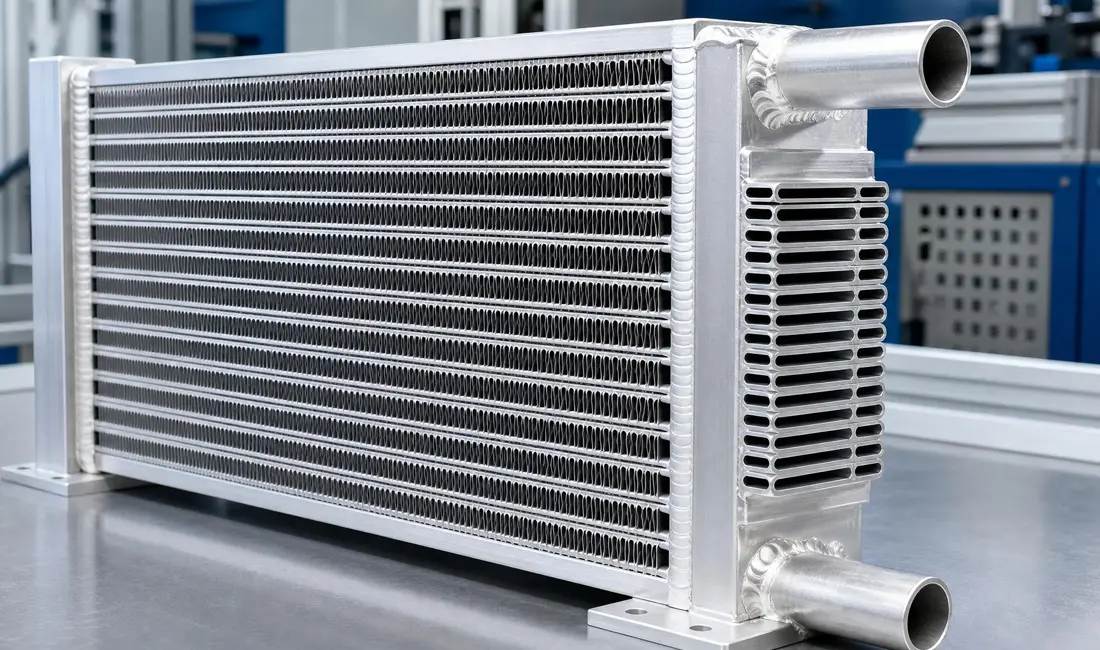
A microchannel heat exchanger, or MCHE, is a compact heat exchanger that uses flat multiport tubes, fins, and headers to move heat between refrigerant or another fluid and air.
The flat tubes contain many small internal flow passages. These passages are called microchannels. Air passes across the outside of the tubes and fins, while the working fluid moves through the small channels inside the tubes.
This design creates a high amount of heat transfer surface in a small volume. The U.S. Department of Energy describes microchannel heat exchangers as systems that use small tubes, often below 2 mm in hydraulic scale, connected in parallel between headers. Their high surface-area-to-volume ratio can reduce exchanger depth and refrigerant volume while maintaining heat transfer capacity.
Flat Multiport Tubes, Fins, and Headers
A typical microchannel heat exchanger has three main parts: flat tubes, fins, and headers.
The flat tubes carry the refrigerant or other working fluid. Each tube contains several small internal passages instead of one large round passage.
The fins sit between the tubes and increase the air-side surface area. Louvered fins are common because they help move air across more surface area and increase heat transfer.
Headers collect and distribute refrigerant between the parallel tubes. Header design is important because uneven flow can reduce heat exchanger performance.
Most commercial MCHE designs use aluminum for the tubes, fins, and headers. This creates a lightweight, brazed core and avoids the copper-to-aluminum galvanic couple found in many traditional copper-tube and aluminum-fin coils. Danfoss, for example, uses an all-aluminum design in its commercial microchannel product range.
How Refrigerant and Air Move Through an MCHE
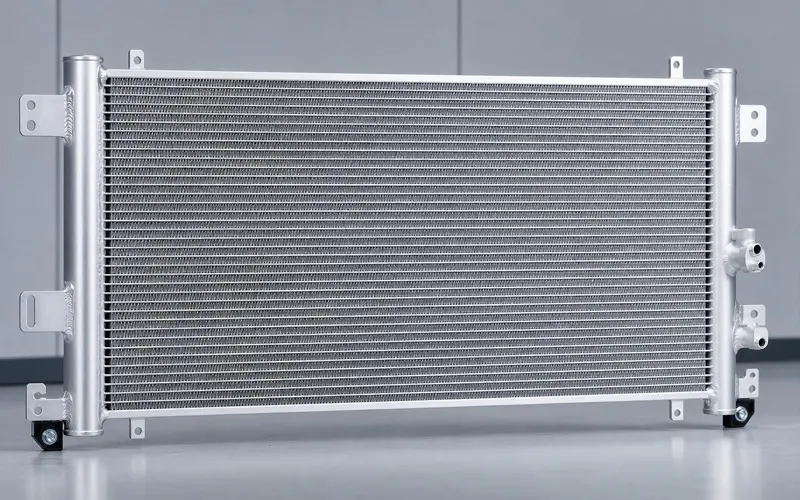
A microchannel heat exchanger works by sending refrigerant through many small parallel channels while air moves across the fins outside the tubes.
The flow path is usually:
Inlet header → flat multiport tubes → outlet header
At the same time, a fan or vehicle motion pushes air across the tube-and-fin core.
Heat moves through the thin aluminum tube walls and then through the fins. In a condenser, heat leaves the refrigerant and moves into the air. In an evaporator, heat moves from the air into the refrigerant.
This parallel flow layout helps create a compact exchanger. It also makes refrigerant distribution important. If some tubes receive much more refrigerant than others, the full heat transfer area cannot be used well.
How Microchannel Differs From Traditional Fin-Tube Construction
The main difference is tube shape and core construction.
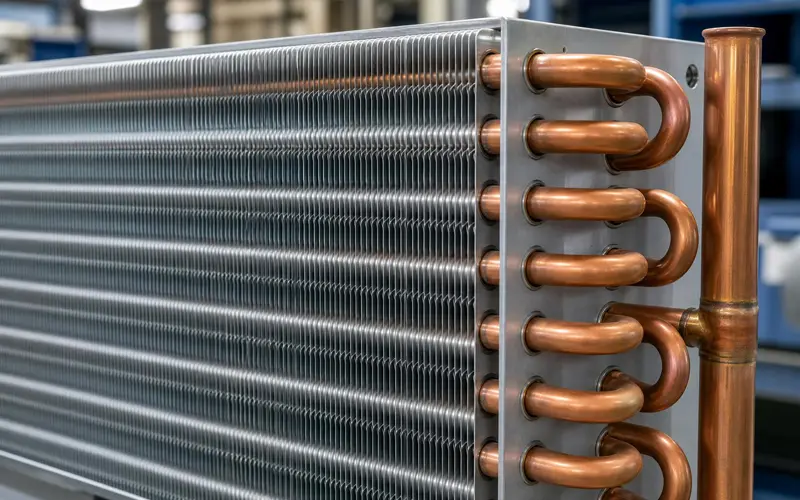
A conventional fin-and-tube coil often uses round copper or aluminum tubes that pass through plate fins. Tube expansion or another joining method creates contact between the tubes and fins. Return bends then connect the tube circuits.
A microchannel heat exchanger usually uses flat aluminum multiport tubes placed between fins. The core is commonly assembled and then brazed as one structure.
This changes several design features at the same time. Tube volume becomes smaller, the core can become shallower, and more flow passages can fit into a small space.
Microchannel vs Fin-Tube Heat Exchangers: Quick Comparison
Microchannel offers clear advantages in compact systems, but traditional fin-tube coils remain useful in applications that need flexible circuiting, easier field repair, or more forgiving wet and frost performance.
| Criteria | Microchannel Heat Exchanger | Traditional Fin-Tube Coil |
| Tube shape | Flat multiport tube | Usually round tube |
| Common materials | Mostly all-aluminum | Often copper tube with aluminum fins |
| Core construction | Commonly brazed | Tube expansion, brazing, welding, or other joining methods |
| Internal refrigerant volume | Usually lower | Usually higher for a similar duty |
| Weight | Often lower | Often higher |
| Core depth | Can be shallow and compact | Often uses more tube rows |
| Air-side surface area | High | High, depending on fin design |
| Refrigerant distribution | Header design is critical | Circuiting is often easier to adjust |
| Field repair | Can be more difficult | Often easier for common copper-tube designs |
| Corrosion behavior | Avoids copper-aluminum galvanic couple in all-aluminum designs | Depends on material pair and coating |
| Frost and drainage | Requires careful design | Can be more forgiving in some heat-pump duties |
| Common uses | Automotive AC, condensers, chillers, compact HVAC, refrigeration | HVAC coils, refrigeration, heat pumps, retrofit coils, custom systems |
The table gives a general comparison. Actual performance depends on tube geometry, fin spacing, airflow, refrigerant, circuit design, coating, and operating conditions.
What Are the Main Advantages of Microchannel Heat Exchangers?
The main benefits of a microchannel heat exchanger are compact size, lower refrigerant charge, lower weight, and good heat transfer per unit volume.
These benefits are most useful when the entire HVAC or refrigeration system is designed around the microchannel core.
Higher Heat Transfer Area in a Smaller Core
Microchannel heat exchangers provide a high surface-area-to-volume ratio.
The flat tubes use many small channels, and the fins add a large air-side contact area. This allows a designer to place a large heat transfer surface inside a compact coil.
The U.S. Department of Energy identifies this compact surface area as one of the main technical benefits of microchannel heat exchangers. A smaller core can help reduce exchanger depth while still meeting system capacity.
This benefit can matter in products with limited space, such as rooftop units, vehicle air conditioners, compact condensing units, and packaged refrigeration equipment.
However, a smaller heat exchanger does not automatically mean lower system energy use. Airflow resistance, fan power, refrigerant pressure drop, and control settings still need to be considered.
Lower Refrigerant Charge
A microchannel heat exchanger usually requires less refrigerant than a comparable conventional coil because its internal tube volume is smaller.
Lower refrigerant charge can reduce material use and help OEMs design more compact refrigerant circuits.
Danfoss states that its MCHE design can use about 30% less refrigerant than a fin-and-tube heat exchanger under the same comparison conditions. This figure should be treated as a product and test example rather than a fixed result for every MCHE.
The actual reduction depends on factors such as coil size, port size, number of passes, refrigerant type, receiver volume, piping, and total system design.
This advantage has become more important as HVAC and refrigeration markets move toward lower-GWP refrigerants and tighter refrigerant management. Current U.S. rules, for example, apply GWP limits to several new air-conditioning, heat-pump, chiller, and refrigeration categories.
Lower Weight and Smaller Equipment Footprint
Microchannel cores can reduce both weight and equipment depth.
Aluminum is lighter than copper, and the compact tube shape reduces the amount of material needed in many designs. A thinner heat exchanger can also allow a smaller cabinet or more internal space for other components.
This makes microchannel attractive in applications such as automotive HVAC, rooftop units, compact outdoor condensers, and mobile cooling equipment.
The real benefit should be judged at system level. A lighter coil is most valuable when it also helps reduce frame weight, cabinet size, transport cost, or installation load.
All-Aluminum Construction and Material Efficiency
All-aluminum microchannel construction can simplify the material combination inside the heat exchanger core.
One useful benefit is that it removes the copper-to-aluminum galvanic couple present in many conventional coils. Danfoss highlights this point in its current MCHE product design.
This does not mean that aluminum cannot corrode.
Aluminum can still suffer from pitting or other forms of corrosion in salt-rich, acidic, industrial, or poorly maintained environments. Alloy choice, surface treatment, coating, drainage, and cleaning method still matter.
For buyers, the correct question is not whether microchannel is corrosion-proof. The better question is whether the material and coating are suitable for the real operating environment.
Good Fit for Automated, High-Volume Manufacturing
Microchannel heat exchangers are well suited to controlled, repeatable production.
A typical production route can include flat-tube straightening, chipless cutting, fin forming, core assembly, header assembly, brazing, and leak testing.
These processes can be automated when production volume is high. This helps manufacturers control tube length, fin pitch, core alignment, and cycle time.
For this reason, MCHE is often attractive to OEMs that make large volumes of similar heat exchanger cores rather than many small batches of highly customized coils.
What Are the Disadvantages of Microchannel Heat Exchangers?
The main disadvantages are more difficult field repair, greater sensitivity to flow distribution, and added design challenges in wet, dirty, or frosting conditions.
These limits do not make MCHE unsuitable. They simply mean that the exchanger must be selected for the correct operating environment.
Field Repair Is More Difficult
Microchannel heat exchangers can be harder to repair in the field than common copper-tube fin coils.
A conventional copper tube can often be accessed, brazed, or repaired with tools that HVAC technicians already use. A brazed aluminum microchannel core needs a different repair method.
Small leaks may also be difficult to reach because the flat tubes and fins form a tightly packed structure.
In some cases, repair is possible. In other cases, replacing the full coil can be more practical.
For this reason, service strategy should be considered before the equipment is designed. Replacement cost, spare-part supply, technician skill, and downtime may matter as much as initial coil efficiency.
Small Flow Passages Require Good Refrigerant Distribution
Microchannel heat exchangers need accurate refrigerant distribution.
The small channels are arranged in parallel, so the inlet header must send refrigerant into many tubes at the correct rate.
Poor distribution can leave some paths with too much refrigerant and others with too little. This can reduce heat transfer and change pressure drop.
The issue becomes more important when two-phase refrigerant flows through the exchanger. Vapor and liquid do not always divide evenly inside a header.
Recent heat-pump research also lists flow maldistribution and pressure drop as important MCHE design limits.
For this reason, tube size, port geometry, pass arrangement, header design, refrigerant state, and oil return should be considered together.
Fouling and Cleaning Need Careful Air-Side Design
Dust and debris can reduce the performance of any finned air heat exchanger.
Typical contaminants include dust, fibers, grease, pollen, and airborne particles.
If the spaces between fins become blocked, airflow falls. Heat transfer also falls, while fan power may increase.
Microchannel cores are often compact, so air-side design and access for cleaning deserve careful attention.
The best cleaning method depends on the fin material, coating, contamination type, and equipment location. Strong brushes, high-pressure water, or harsh chemicals can damage thin fins or protective coatings.
Manufacturers should therefore design service access at the same time as the coil.
Corrosion Resistance Depends on the Environment
All-aluminum construction reduces one corrosion mechanism, but it does not remove every corrosion risk.
Coastal air can contain salt. Industrial locations can contain acidic or reactive chemicals. Road vehicles can face moisture, road salt, dirt, and temperature cycling.
These conditions can still attack aluminum surfaces.
For harsh service, designers may need protective coatings, suitable alloys, good drainage, and regular cleaning.
Traditional fin-tube coils also face corrosion risk. The correct comparison should therefore consider the exact materials and environment instead of assuming one design is always more resistant.
Frosting, Drainage, and Defrost Can Be Challenging
Frost and water drainage are important design issues for microchannel heat exchangers used as outdoor evaporators.
When the coil surface operates below freezing in humid air, frost can build on the fins. This increases air-side resistance and reduces heat transfer.
Water left on the coil after defrost can also affect the next frosting cycle.
A 2025 review of microchannel heat exchangers in heat pumps identifies frosting, pressure drop, and flow distribution as important limits that still need careful design.
More recent 2026 research is also testing vertical-fin and vertical-tube designs to improve drainage. One study found that changing the coil geometry could reduce retained water and improve heat transfer under frosting and defrosting conditions.
This shows why MCHE should not be treated as a direct replacement for every outdoor heat-pump coil.
Where Is Microchannel Replacing Fin-Tube Heat Exchangers?
Microchannel is replacing conventional fin-tube coils most often in applications where lower charge, lower weight, compact size, and high-volume production matter.
The replacement trend is strongest where the system can be designed around the MCHE instead of using it as a simple drop-in coil.
Automotive Air-Conditioning Condensers
Automotive air conditioning is one of the most established microchannel applications.
Vehicles need a heat exchanger that is light, thin, and able to reject heat with limited front-end space.
Microchannel construction fits these needs because flat multiport tubes and fins can create a compact condenser with low refrigerant volume.
The U.S. Department of Energy notes that microchannel heat exchangers were originally developed for automotive air-conditioning use before expanding into other HVAC applications.
Weight reduction is also important in vehicles because every component affects total vehicle mass.
For these reasons, automotive condensers remain one of the clearest examples of microchannel replacing older round-tube designs.
Residential and Commercial AC Condensers
Microchannel is also used in residential and commercial air-conditioning condensers.
Outdoor condensing units can benefit from a thinner coil, lower refrigerant charge, and lighter structure.
Danfoss currently lists residential and commercial air conditioning as core MCHE applications.
This does not mean every outdoor AC unit should use microchannel.
OEMs still need to compare corrosion exposure, service access, target capacity, refrigerant type, fan design, and cost before changing coil technology.
Commercial Refrigeration Condensers
Commercial refrigeration is another strong area for microchannel use.
Applications can include condensing units, refrigerated display systems, packaged refrigeration equipment, and other air-cooled systems.
These products can benefit from reduced refrigerant volume because the full refrigeration system may contain several heat exchangers, long piping runs, and multiple control components.
A smaller condenser charge can support a wider system goal of reducing total refrigerant inventory.
The benefit is strongest when the manufacturer designs the piping, receiver, compressor, and controls around the new coil rather than replacing only one component.
Chillers and Packaged Cooling Equipment
Microchannel can replace traditional fin-tube coils in the air-cooled condenser section of some chillers and packaged cooling systems.
An air-cooled chiller must reject heat to outdoor air. This makes the condenser a natural location for a compact air-to-refrigerant heat exchanger.
Reducing coil depth and weight can help with equipment footprint and frame design.
However, condenser selection still depends on ambient temperature range, fan system, noise target, refrigerant pressure, cleaning access, and corrosion environment.
Data Center and Free-Cooling Systems
Microchannel is also being used in some data-center cooling and free-cooling systems.
These systems may require high heat rejection in a limited equipment area. Low weight and compact core depth can help increase cooling density.
Danfoss lists free-cooling cycles for data centers among current MCHE applications.
This area is also becoming more relevant as data-center cooling systems face tighter energy and refrigerant requirements.
In the United States, current HFC transition rules include a GWP limit for data-center and computer-room cooling equipment with a 2027 compliance date for covered products and systems.
Heat Pumps: Growing, but Not a Universal Replacement
Microchannel is gaining attention in heat-pump systems, but it has not replaced fin-tube coils across all climates and designs.
The compact size and lower refrigerant charge are attractive. These benefits can support smaller outdoor units and lower refrigerant inventory.
The main challenge is that a heat-pump outdoor coil must often work as both a condenser and an evaporator.
During heating mode, the outdoor coil may face rain, condensation, frost, and repeated defrost cycles.
Recent research continues to study fin geometry, tube direction, drainage, and frost behavior in microchannel heat exchangers.
A 2026 experimental study comparing finned-tube and microchannel heat exchangers in a CO₂ heat-pump system found that the finned-tube exchanger had a shorter defrost duration under the tested conditions. This does not prove that fin-tube is always better, but it shows that frost performance depends strongly on exchanger design and operating conditions.
Where Fin-Tube Still Has an Advantage
Traditional fin-tube coils still have clear value where serviceability, flexible circuiting, retrofit compatibility, or difficult environmental conditions are more important than minimum size.
For many manufacturers, the choice is not “old technology versus new technology.” It is a tradeoff between two proven heat exchanger structures.
Retrofit and Replacement Coils
Fin-tube coils are often easier to use in retrofit projects.
Existing HVAC and refrigeration equipment may already be designed around round tubes, return bends, fixed connection points, specific coil depths, and known airflow.
Replacing that coil with microchannel may require changes to the cabinet, refrigerant charge, piping, controls, airflow, or mounting system.
For this reason, microchannel should not be treated as a direct drop-in replacement unless the full system has been checked.
Applications That Need Easy Field Repair
Traditional copper-tube fin coils can be easier to repair in many service markets.
Technicians are familiar with copper tube brazing, leak repair, and tube circuit work.
This can reduce downtime when a system operates far from the original equipment manufacturer.
For industrial equipment, remote installations, or long-life service systems, this repair advantage can matter more than a small reduction in coil weight.
Heavy Fouling or Harsh Operating Conditions
A traditional fin-tube coil can also be easier to customize for dirty environments.
Manufacturers can adjust fin spacing, tube diameter, row count, material, and coating to match the application.
Applications with heavy dust, fibers, oil mist, or plant debris may need wider fin spacing and easy cleaning access.
Microchannel can also be designed for difficult environments, but the compact core must be selected carefully.
Heat Pumps With Severe Frosting Conditions
Fin-tube still has an advantage in some cold-climate heat-pump applications.
Its larger flow paths and familiar fin layouts can provide useful drainage and service flexibility.
Microchannel heat exchangers can work in heat pumps, but frost and defrost behavior must be designed carefully. Research results show that tube orientation, fin geometry, refrigerant distribution, and water retention all affect performance.
For this reason, climate and winter operation should be part of the heat exchanger selection process.
Microchannel vs Fin-Tube: Which One Should OEM Buyers Choose?
OEM buyers should choose microchannel when system compactness, low refrigerant charge, lower weight, and repeatable high-volume production are major goals.
Fin-tube may still be the better choice when field repair, custom circuiting, retrofit fit, or severe fouling and frost conditions are more important.
A useful selection process should review six main factors: heat duty, refrigerant, airflow, service environment, manufacturing volume, and maintenance strategy.
For example, a large batch of compact outdoor condensers may favor microchannel. A low-volume custom industrial coil with frequent field repair may favor fin-tube.
The decision should also include total production cost. A microchannel core may reduce some material use, but it can require different tube preparation, fin forming, core assembly, brazing, and quality-control equipment.
How Microchannel Heat Exchangers Are Manufactured
Microchannel heat exchanger production depends on accurate flat-tube preparation, fin forming, core assembly, brazing, and leak testing.
Small dimensional errors can affect tube fit, fin contact, header assembly, and final heat exchanger performance.
Flat Microchannel Tube Preparation
Flat microchannel tubes must be straight, clean, and cut to a controlled length before core assembly.
Common steps include straightening, chipless cutting, length control, and end preparation.
The tube surface should also be protected from scratches or deformation because the walls and internal ports can be thin.
BOBO Machine currently lists equipment for straightening, chipless cutting, and preparing flat or microchannel tubes for brazing and assembly. Its tube equipment range also includes dedicated microchannel flat-tube cutting and straightening options.
For manufacturers planning this part of a line, microchannel flat tube straightening and cutting equipment can be matched to tube size, cutting method, surface protection, and required production rate.
Fin Forming and Cutting
Fin quality affects both heat transfer and airflow resistance.
Typical microchannel fins may use louvered, wavy, or other formed patterns. The exact design depends on the exchanger and application.
The production line must control fin height, pitch, wave or louver geometry, and cut length.
Poor fin consistency can create uneven spacing inside the core. This may affect airflow and make later tube insertion more difficult.
For high-volume production, automatic fin forming and cutting can improve repeatability.
Core Assembly and Tube Insertion
Core assembly brings the flat tubes, fins, side plates, and headers into the correct position.
Tube spacing and fin alignment need to remain stable before brazing.
Automated systems can feed fins and flat tubes, control spacing, and assemble the core before later joining steps.
BOBO Machine’s current fin and finned-tube equipment range includes automatic radiator core production solutions that cover fin rolling, flat-tube insertion, side-plate assembly, and related core-forming steps.
Manufacturers that need this type of process can review fin and finned tube processing machinery for fin forming, tube insertion, assembly, and custom production-line options.
Brazing and Final Quality Control
Most aluminum microchannel cores require controlled brazing after assembly.
The core must maintain its shape while the joints between tubes, fins, and headers are formed.
After brazing, manufacturers may carry out leak testing, dimensional inspection, flow checks, pressure testing, and visual inspection.
The exact test plan depends on the heat exchanger application and the required standard.
Quality control is important because a small leak or blocked flow passage can affect the whole refrigerant circuit.
For this reason, tube preparation, fin forming, assembly, brazing, and inspection should be treated as one connected production process rather than separate machine operations.
Microchannel Heat Exchanger Trends in 2026
Microchannel development in 2026 is being shaped by lower-GWP refrigerants, lower charge targets, compact HVAC systems, and improved heat-pump designs.
The technology itself is not new, but its application range continues to expand.
Lower Refrigerant Charge for Low-GWP Systems
Lower refrigerant charge is becoming more valuable as HVAC and refrigeration systems move toward lower-GWP alternatives.
In the United States, current technology-transition rules set GWP limits across several equipment groups, including residential and light commercial air conditioning, heat pumps, chillers, and industrial refrigeration. Compliance dates vary by category.
Microchannel does not solve the refrigerant transition by itself.
However, its lower internal volume can help manufacturers reduce total system charge when the full system is designed correctly.
This is one reason MCHE remains relevant even when the refrigerant itself changes.
More Microchannel Use in Heat Pumps
Heat pumps are an important development area for microchannel heat exchangers.
Research is moving beyond simple dry-coil condenser operation and looking more closely at heating mode, frost, drainage, and defrost.
The 2025 review of heat pumps and MCHE development found clear benefits in compactness and reduced charge, but it also identified frosting, pressure drop, and flow distribution as limits that still need better design.
In 2026, new experimental work is still testing tube and fin layouts that improve drainage and frost behavior.
This suggests that microchannel use in heat pumps is expanding through design improvement rather than through simple replacement of every traditional coil.
Smaller and More Integrated Thermal Systems
OEMs continue to look for smaller and lighter thermal systems.
This applies to automotive equipment, rooftop HVAC units, compact refrigeration, data-center cooling, and other packaged systems.
Microchannel helps support this trend because it can place a high heat transfer area inside a relatively thin core.
The U.S. Department of Energy still classifies microchannel heat exchangers as a commercially available HVAC technology with energy-saving potential and lower refrigerant charge as a non-energy benefit.
For equipment manufacturers, this trend also affects the factory. Higher automation, more accurate flat-tube processing, and consistent core assembly become more important as heat exchanger dimensions become smaller.
FAQs About Microchannel Heat Exchangers
Is a Microchannel Heat Exchanger More Efficient Than Fin-Tube?
A microchannel heat exchanger can provide higher heat transfer performance per unit volume, but it is not always more efficient at system level.
A fair comparison must use the same capacity, airflow, refrigerant, inlet temperatures, fan power, and pressure-drop limits.
Microchannel can be very effective when compact size is important. A well-designed fin-tube coil can still perform better in other operating conditions.
How Much Refrigerant Can a Microchannel Heat Exchanger Save?
The refrigerant reduction depends on the exchanger and system design.
Danfoss reports about a 30% charge reduction for its MCHE under the same comparison conditions against fin-and-tube designs.
Other systems may show a different result.
The final charge depends on the heat exchanger volume, piping, receiver, compressor, refrigerant, and control strategy.
Can a Microchannel Coil Directly Replace a Fin-Tube Coil?
No. A microchannel coil should not be treated as an automatic drop-in replacement.
The system should be checked for cooling or heating capacity, refrigerant charge, pressure drop, airflow, circuiting, cabinet size, connection position, and control settings.
A successful conversion may require changes outside the coil itself.
Can Microchannel Heat Exchangers Be Repaired?
Some microchannel heat exchangers can be repaired, but field repair can be more difficult than on common copper-tube coils.
The repair method depends on leak location, aluminum alloy, access, and service tools.
In some cases, replacing the complete coil may be more practical.
Are Microchannel Heat Exchangers Suitable for Heat Pumps?
Yes, microchannel heat exchangers can be used in heat pumps.
However, the outdoor heat exchanger must be designed for wet operation, frost, water drainage, and defrost.
Recent studies show that tube position, fin design, refrigerant distribution, and retained water can all affect winter performance.
Do Microchannel Heat Exchangers Corrode?
Yes. Aluminum microchannel heat exchangers can still corrode.
All-aluminum construction removes the copper-aluminum galvanic couple, but aluminum can still be affected by salt, chemicals, moisture, and industrial pollution.
Coatings, material selection, drainage, cleaning, and installation environment should all be considered.
Conclusion: Microchannel Is Expanding, Not Replacing Every Fin-Tube Coil
Microchannel heat exchangers are replacing conventional fin-tube coils where compact size, lower refrigerant charge, lower weight, and high-volume production offer clear system benefits.
They are already well established in automotive air conditioning and are widely used in air-cooled HVAC and refrigeration equipment. Their use is also expanding into heat pumps, data-center cooling, and other compact thermal systems.
Traditional fin-tube coils still have an important role. They can offer easier field repair, flexible tube circuiting, good retrofit compatibility, and useful performance in some dirty or severe frosting conditions.
For manufacturers, the move to microchannel also changes the production process. Flat-tube straightening and cutting, accurate fin forming, core assembly, and brazing preparation become central steps.
BOBO Machine supplies tube and fin processing equipment for heat exchanger manufacturing, including flat and microchannel tube processing and automatic fin/core assembly solutions. Manufacturers planning a new line or changing from conventional fin-tube production can use BOBO Machine’s heat exchanger manufacturing equipment range to match equipment with tube size, fin design, production volume, and factory layout.
Want to Know More About Our Products?
View All Products Now