Hydroforming Heat Exchanger Headers and Manifolds: When It Beats Welding & Forming
Jump to section
Hydroforming shapes a heat exchanger header from a single tube using high-pressure fluid. It offers fewer welds, tighter tolerances, and better leak integrity than welding and forming. But it does not win every time.
This guide explains how hydroforming works for headers and manifolds, where it beats the older methods, and where welding or forming still makes sense. It is written for readers, such as coil makers, design engineers, and procurement teams. The goal is to help a plant choose the right way to make its headers.
What Are Heat Exchanger Headers and Manifolds?
A header, also called a manifold, is the part that feeds fluid into the coil tubes and collects it again. It sits at each end of the tube bundle and links the coil to the plant piping. The header spreads the flow across many tubes, then gathers it after the heat exchange. It also acts as a pressure boundary, so it must hold the fluid safely. Header pressures range widely, from near atmospheric to over 200 bar in high-pressure services. Because it seals pressure and sets tube spacing, the header shapes the quality of the whole unit. A leak or a poor fit here can fail the entire heat exchanger.
How Headers and Manifolds Are Traditionally Made (Welding & Forming)
Traditional headers are built by welding or forming metal into shape. Most methods start with flat plate, sheet, or solid bar. They then cut, form, and join the parts into a sealed box or tube. Three methods are common, such as welded box headers, machined-from-slab headers, and rolled-and-brazed manifolds. The parts below explain each one and its trade-offs.
Welded Box Headers
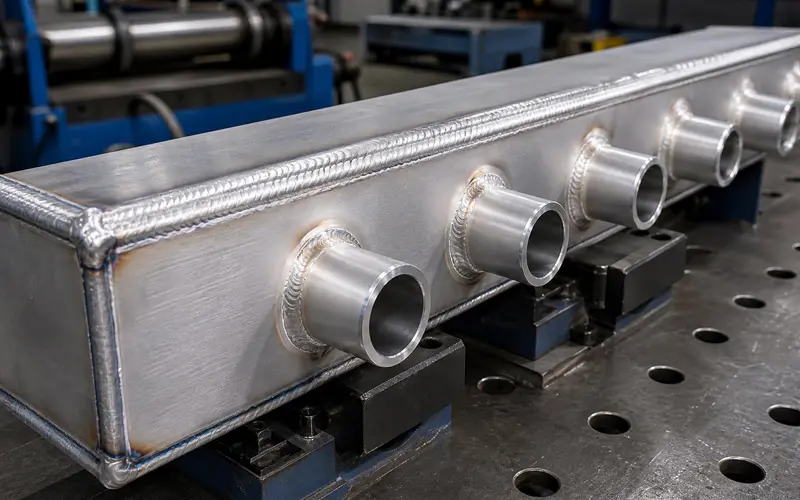
A welded box header is made from several flat plates joined by welds. A typical box uses six plates, such as a tube sheet, a plug sheet, two wrapper plates, and two end blocks. Workers weld these plates into a sealed rectangular box. This method is strong and suits high pressure. But each weld is a possible leak path, and the heat can warp the plates. The many welds and checks also add labor and time.
Machined-from-Slab Headers
A machined header starts as a solid block of metal. A machine bores a hole, mills out an inner chamber, and drills the tube and plug holes. An end block is then welded on to close the chamber. This method gives a strong, precise part with few seams. But it removes a lot of metal, which wastes material and raises cost. The long machining time also limits output.
Rolled and Brazed Manifolds
A rolled manifold starts as a flat sheet that is bent into a tube. The plant forms tube slots in the sheet, then rolls it into a cylinder and joins the seam by brazing or welding. This method is fast and low in cost for round manifolds. But the long seam can leak if the joint is not tight. A weak seam is a common failure point in this design.
How Hydroforming Shapes Headers and Manifolds
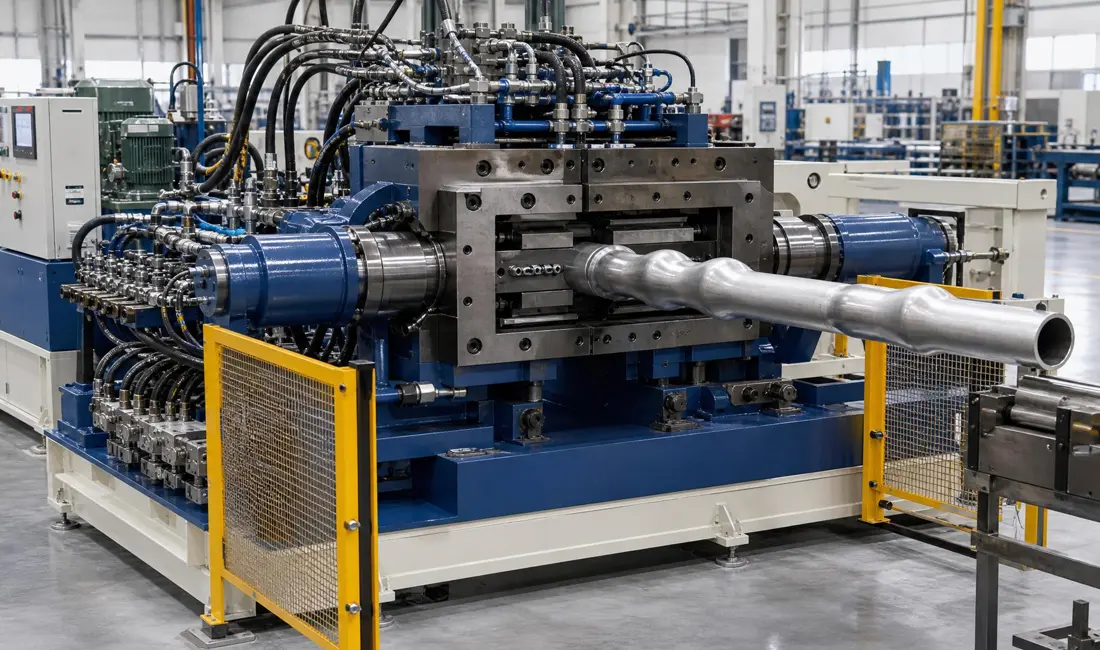
Hydroforming forms a header from a single tube using fluid pressure. It replaces many cut-and-weld steps with one forming step. The tube becomes the finished shape without a long seam. The two parts below explain the process and the two main types.
The Tube Hydroforming Process Step by Step
The process shapes a tube inside a closed die. First, a machine places a straight tube into a die cavity shaped like the finished header. Next, metal punches seal both ends of the tube. The machine then fills the tube with a fluid, such as water, oil, or an emulsion, and pushes out any air. Pressure rises next, sometimes up to 100,000 psi, until the tube wall presses against the die. For a manifold, the die adds bulges that form the tube slots. A final step pierces these slots, which leaves a smooth, round bore. The result is a one-piece header with no long weld seam.
Sheet vs Tube Hydroforming
Hydroforming comes in two main types, such as tube hydroforming and sheet hydroforming. Tube hydroforming starts with a hollow tube and is the common choice for round manifolds. Sheet hydroforming starts with a flat sheet that fluid presses into a die. Tube hydroforming suits seamless, closed shapes, while sheet hydroforming suits open, shallow parts. For most heat exchanger headers, the tube method fits best.
Key Advantages of Hydroforming for Headers and Manifolds
Hydroforming brings four main gains over welding and forming, such as fewer welds, part consolidation, tight tolerances, and lower weight. Each one matters for a header. The parts below explain them in turn.
Fewer Welds and Better Leak Integrity
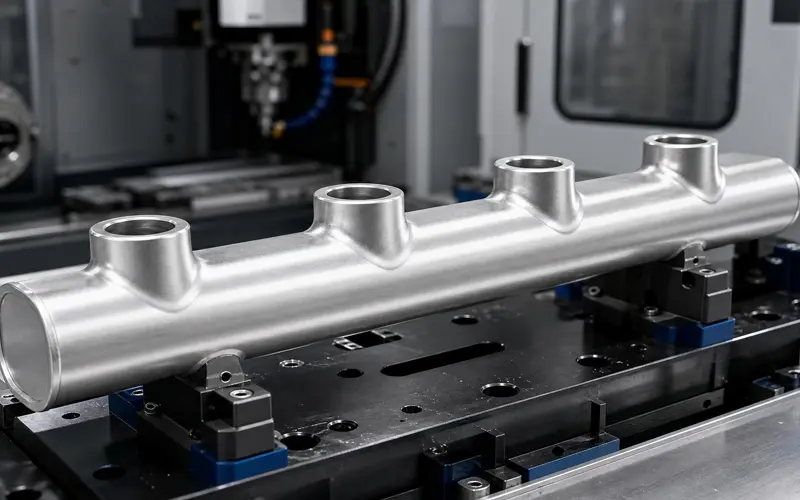
Hydroforming removes most of the welds from a header. A welded box header may have many seams, while a hydroformed header has few or none along its body. Fewer seams mean fewer leak paths, which is vital for a pressure boundary. A seamless body also has no weld distortion to correct. This gain makes hydroforming attractive for leak-critical coils, such as refrigerant, hydrogen, and high-pressure units.
Part Consolidation and Lower Assembly Cost
Hydroforming turns many parts into one. A welded header needs several plates, plus the labor to align and weld them. A hydroformed header forms in a single step, so the plant handles fewer parts. Fewer parts mean less cutting, less welding, and less inspection. This cuts assembly cost and speeds up the line.
Tight Tolerances and Consistent Bore
Hydroforming holds tight, repeatable dimensions. The fluid presses the whole wall at once, so the shape stays even along the length. Springback is low, since the wall sets against a solid die. Tube-slot spacing also stays precise, which helps the tubes seat well later. A consistent bore keeps flow even across the coil.
Weight Reduction and Material Savings
Hydroforming lets a header be lighter without losing strength. The even forming lets the plant use a thinner wall that still holds pressure. It also wastes little material, often keeping scrap to around 0 to 10 percent. A machined header, by contrast, cuts away much of the block. Less weight and less waste both lower the cost per part.
When Hydroforming Beats Welding and Forming
Hydroforming is not always the best choice. It wins in some cases and loses in others. A buyer should weigh the shape, the pressure, the volume, and the budget. The two parts below give a clear rule for each side.
When Hydroforming Is the Better Choice
Hydroforming fits complex, leak-critical headers made in steady numbers. It suits parts with curved or variable shapes that are hard to weld. It shines when leak integrity is vital, since it cuts the number of seams. It also fits mid-volume runs, where the tooling cost spreads over enough parts. Coils in fields, such as automotive, refrigeration, and aerospace, often use it for these reasons. For these jobs, hydroforming lowers both leaks and assembly cost.
When Welding or Forming Still Makes Sense
Welding and forming still win in several cases. Very high-pressure, thick-wall box headers, such as those in API 661 air coolers, rely on welded plates for their strength. Simple, flat, or boxy shapes are also easy to weld and may not need hydroforming. Very small runs favor welding too, since hydroforming tooling costs too much to justify for a few parts. Some headers also need plug holes for cleaning and repair, which a welded box provides. In these cases, the older methods remain the smart choice.
Hydroforming vs Welding vs Forming: Comparison Table
The table below sets the three methods side by side. It shows where each one is strong and where it is weak.
| Factor | Hydroforming | Welded Box Header | Machined / Rolled Forming |
| Welds / leak paths | Few or none | Many seams | Some (seam or end weld) |
| Dimensional accuracy | High, low springback | Affected by weld distortion | Medium to high |
| Part count / assembly | One piece | Several plates | Few parts |
| Weight | Low, thin wall | Higher | Higher |
| Material waste | Low (0 to 10%) | Medium | High (machined) |
| Tooling cost | High | Low to medium | Medium to high |
| Best volume | Mid volume | Any, flexible | Low volume |
| High-pressure, thick wall | Medium to high | Best | Medium to high |
| Serviceability | Sealed, hard to open | Plug holes for cleaning | Varies |
| Best fit | Complex, leak-critical | Very high pressure, serviceable | Simple shape, tiny runs |
This table is a general guide. The right method still depends on the header design and the plant’s volume.
Choosing a Header Manufacturing Setup
The right way to make a header depends on the part, not on the method alone. A buyer should weigh the shape, the pressure rating, the leak spec, and the volume. Complex, sealed, mid-volume headers point toward hydroforming. Simple or very high-pressure headers point toward welding. Very small runs point toward machining or forming. Buyers who need custom or specialized tube forming can work with a custom tube processing partner to match the process to their design. The right partner helps balance quality, cost, and lead time.
Frequently Asked Questions
Is hydroforming cheaper than welding a header?
It depends on the volume. Hydroforming has a high tooling cost, so it is dear for a few parts. Over a mid-volume run, it often costs less per part than welding, since it cuts labor and inspection. For very small runs, welding usually wins on cost. A buyer should compare the total cost across the full order.
Can hydroformed manifolds handle high pressure?
Yes, within limits. Hydroformed manifolds suit low, medium, and many high-pressure jobs. For very high pressure with thick walls, such as some API 661 air coolers, welded box headers are often stronger. The safe limit depends on the material, the wall thickness, and the design. A buyer should match the method to the pressure rating.
What materials can be hydroformed for headers?
Many common metals can be hydroformed. These include metals, such as aluminum, copper, and stainless steel. Softer metals, such as aluminum and copper, form with ease at lower pressure. Harder metals, such as stainless steel, need higher pressure and stronger tooling. The choice depends on the header’s strength and corrosion needs.
Is hydroforming worth it for low production volumes?
Often not. Hydroforming needs costly dies and high-pressure equipment. This upfront cost is hard to justify for a few parts. For low volumes, welding or machining usually gives better value. Hydroforming pays off best when the run is large enough to spread the tooling cost.
Conclusion: Choosing the Right Header Manufacturing Method
The best header method depends on the design, the pressure, and the volume. Hydroforming wins for complex, leak-critical headers made in steady numbers, since it cuts welds and holds tight tolerances. Welding still leads to very high-pressure box headers and serviceable designs. Forming and machining suit simple shapes and small runs. A buyer who matches the method to the part will get a header that seals well and costs less to build. For custom or specialized tube forming needs, teams can explore options with a custom tube processing partner or start the conversation on the contact page.
Want to Know More About Our Products?
View All Products Now