Louvered vs Slit vs Wavy vs Plain Fin: Heat Transfer & Pressure Drop Trade-offs
Jump to section
Fin geometry decides how much heat a coil moves and how hard the air must push through it. Four fin types cover most finned coils, such as louvered, slit, wavy, and plain fins. Each type trades heat transfer against pressure drop in its own way. A fin that moves more heat also resists airflow more, which raises fan power.
This guide compares the four types in plain terms for readers, such as coil designers, HVAC engineers, and procurement teams. The goal is to help a plant pick the fin that fits its coil, not just the one with the highest heat transfer.
Fin Types at a Glance: Louvered, Slit, Wavy, and Plain
The four fin types line up in a clear order. Heat transfer rises from plain to wavy to slit to louvered. Pressure drop rises in the same order, so the best heat transfer also brings the highest airflow resistance. A plain fin moves the least heat but resists air the least. A louvered fin moves the most heat but resists air the most. Wavy and slit fins sit in between. The whole choice is a trade-off between heat transfer and fan power, which the rest of this guide explains.
Why Fin Geometry Drives Heat Transfer and Pressure Drop
On most finned coils, the air side is the bottleneck. Heat moves easily through the metal and the fluid inside. But it moves slowly from the fin surface into the passing air. A thin layer of still air clings to each fin, and this layer slows heat transfer. Fin shapes work by breaking up this still layer. A shape that stirs the air more moves more heat. But stirring the air also makes it harder to push through the coil, which raises pressure drop. Higher pressure drop then needs a bigger fan and more power. Every fin design lives inside this trade-off, such as more heat versus more fan power.
The Four Fin Types Explained
The four types differ in how much they disturb the airflow. They range from a smooth plain fin to a heavily cut louvered fin. The parts below explain each one, with its heat transfer and its pressure drop.
Plain Fin
A plain fin is a flat, smooth sheet with holes for the tubes. It is the simplest and cheapest fin to make. Air flows across it in straight, calm paths, so it moves the least heat of the four. But those calm paths also give it the lowest pressure drop. A plain fin resists fouling and frost well, since it has no cuts or pockets to trap dirt. It also cleans easily. For these reasons, it suits coils where low airflow resistance and easy cleaning matter most.
Wavy Fin
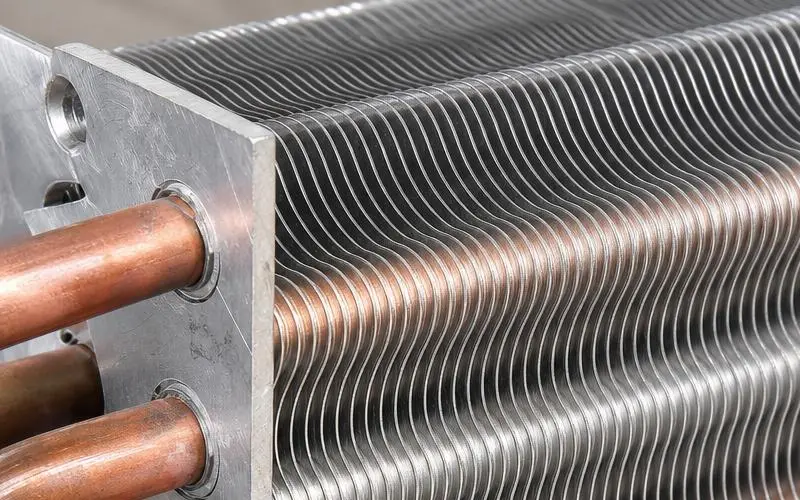
A wavy fin is a sheet pressed into a corrugated, up-and-down shape. The waves make the air follow a longer, curving path across the fin. This longer path and the changing direction mix the air and boost heat transfer. Compared with a plain fin, a wavy fin moves about 3 percent more heat, with about 27 percent more pressure drop. It still handles dust and frost fairly well, since it has no open cuts. This balance makes the wavy fin a common, all-round choice for HVAC coils.
Slit Fin
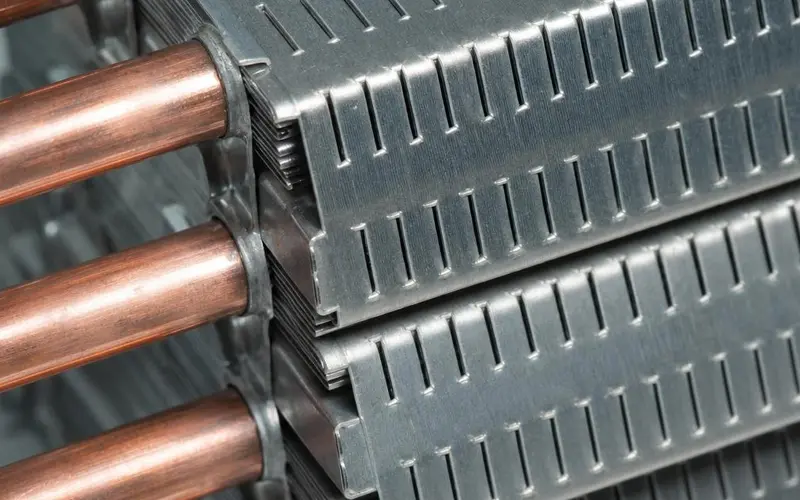
A slit fin has rows of small cuts, or slits, raised from the fin surface. Each slit breaks the still air layer and starts a fresh one at its leading edge. This boundary-layer restart, plus the extra mixing, lifts heat transfer well. Compared with a plain fin, a slit fin moves about 13 percent more heat, but with about 70 percent more pressure drop. The open slits also trap dust and frost more easily, so they clog faster in dirty or cold air. A slit fin suits high-performance coils in clean conditions.
Louvered Fin
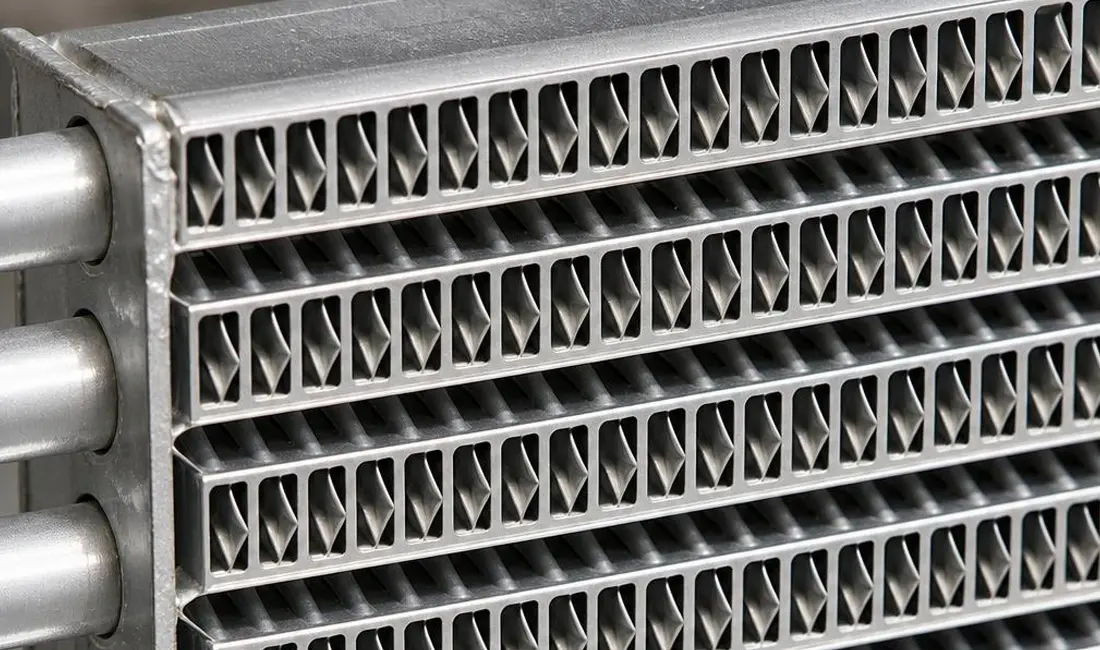
A louvered fin has many angled blades, or louvers, cut and bent across the fin. These louvers act like a row of small, tilted vanes that guide and stir the air. They restart the boundary layer many times, so a louvered fin moves the most heat of the four. But the many blades also block the air the most, which gives the highest pressure drop. This heavy resistance needs a strong fan, and the fine gaps clog quickly with dust or frost. A louvered fin suits compact, high-output coils, such as automotive radiators, condensers, and charge air coolers, where fan power is available.
Heat Transfer vs Pressure Drop: The Core Trade-off
The four fins show one clear rule: more heat transfer costs more pressure drop. A louvered fin may move far more heat than a plain fin, but it also demands far more fan power. This is why the highest heat transfer is not always the best choice. Engineers often measure net efficiency, which weighs heat transfer against the pumping power it costs. By this measure, a louvered fin can lose ground, since its pressure drop penalty is so steep. A wavy or slit fin sometimes gives better net efficiency for the same fan power. The right fin depends on how much fan power and cost a design can accept. Heat transfer alone should not decide it.
Fin Type Comparison Table
The table below sets the four fin types side by side. It shows how each one balances heat transfer, pressure drop, and other needs.
| Factor | Plain Fin | Wavy Fin | Slit Fin | Louvered Fin |
| Heat transfer | Lowest (baseline) | Medium (about +3%) | Higher (about +13%) | Highest |
| Pressure drop | Lowest | Medium (about +27%) | Higher (about +70%) | Highest |
| Fan power needed | Low | Medium | Higher | High |
| Fouling / frost resistance | Good | Fairly good | Poorer | Poor (clogs easily) |
| Tooling cost / complexity | Low | Medium | Higher | High |
| Typical use | Low-drag, easy-clean, frost duty | General HVAC | High-performance HVAC | Automotive, compact coils |
This table is a general guide. The exact numbers change with fin pitch, air speed, and coil design.
Fin Pitch: Another Lever on Performance
Fin type is not the only choice that shapes a coil. Fin pitch, the spacing between fins, also has a strong effect. A tighter pitch packs more fin area into the coil. This raises heat transfer, but it also raises pressure drop. A tight pitch clogs faster with dust or frost too. A wider pitch does the reverse. It gives less heat transfer, but lower resistance and easier cleaning.
Fin pitch and fin type work together. A plant may pair a plain fin with a tight pitch to lift heat transfer. It may also pair a louvered fin with a wider pitch to ease airflow. Fin collar height and pitch are set during fin forming, so they must be planned with the fin type.
How to Choose the Right Fin for Your Coil
The right fin depends on the whole coil, not on heat transfer alone. A buyer should weigh the use, the air quality, and the fan power. The three parts below turn this into a clear rule.
Match the Fin to the Application
Each fin type suits certain products. A louvered fin fits compact, high-output coils, such as automotive radiators, condensers, and microchannel coils. A slit fin fits high-performance HVAC coils in clean air. A wavy fin fits general HVAC work, where balance matters. A plain fin fits coils that need low airflow resistance or frequent cleaning. Matching the fin to the product is the first step.
Consider Fouling, Frost, and Cleaning
Air quality can change the choice completely. Interrupted fins, such as slit and louvered fins, have many cuts and gaps that trap dust and frost. These fins clog faster, which cuts airflow and performance over time. A plain or wavy fin handles dirty or cold air far better, since it has fewer traps. For coils in dusty plants or cold rooms, a simpler fin often wins. Easy cleaning is a real benefit in these settings.
Balance Performance Against Fan Power and Cost
The heat transfer gain must be worth its cost. A high-performance fin raises fan power, which adds to the energy bill for the life of the coil. It also needs more complex tooling, which raises the fin cost. A buyer should weigh the heat transfer gain against these added costs. Sometimes a wavy or slit fin gives the best value once fan power and tooling are counted. The goal is the best net result, not the highest heat transfer.
How Fin Geometry Is Made (Fin Dies and Tooling)
All four fin types start as flat metal strip. A fin press stamps the strip with a progressive die that cuts the tube holes and forms the shape. A plain fin needs a simple die, while a louvered or slit fin needs a precise, complex one. The die must cut and bend many small features without tearing the metal. Changing the fin type usually means changing the die and its setup. A plant that plans to run several fin types needs a machine and tooling built for that range. Buyers can review options for this step on the fin processing machine page to match the tooling to their fin design.
Frequently Asked Questions
Which fin type has the best heat transfer?
The louvered fin has the best heat transfer of the four. Its many angled blades stir the air and restart the boundary layer often. But it also has the highest pressure drop, so it needs the most fan power. The best heat transfer is not always the best overall choice.
Do louvered fins always outperform plain fins?
Not always. A louvered fin moves much more heat, but it also raises pressure drop and fan power sharply. It clogs faster in dust or frost too. For net efficiency, easy cleaning, or low fan power, a plain or wavy fin can be the better pick. The best fin depends on the whole design.
Which fin type is best for dusty or frosty conditions?
A plain or wavy fin handles dust and frost best. These fins have few cuts or pockets to trap dirt and ice. Interrupted fins, such as slit and louvered fins, clog faster in these conditions. For outdoor, cold, or dusty coils, a simpler fin keeps airflow steady longer.
Can one fin machine make different fin types?
Often, yes, with the right tooling. The fin type is set mostly by the die, so changing the die can change the fin. A machine built for a range of dies can make plain, wavy, slit, or louvered fins. A buyer should confirm the machine’s die range and changeover before choosing.
Conclusion: Choosing the Right Fin for the Job
The four fin types trade heat transfer against pressure drop in a clear order. A louvered fin moves the most heat but costs the most fan power and clogs the fastest. A plain fin moves the least heat but resists air the least and cleans the easiest. Wavy and slit fins balance the two, and often give the best value once fan power and tooling are counted. The right fin is the one that fits the application, the air, and the budget, not simply the one with the highest heat transfer. A plant weighing a new fin design can compare tooling on the fin processing machine page, or send its coil requirements to the contact page to talk through the options.
Want to Know More About Our Products?
View All Products Now